
An app development NDA is a legally binding contract that restricts developers, contractors, and partners from disclosing or misusing your confidential app-related information. Formally called a non-disclosure agreement, this document is the first legal layer protecting your source code, business strategy, and product roadmap before a single line of code is written. Under the US Defend Trade Secrets Act, misappropriation of trade secrets can result in damages up to double the compensatory award, which means the stakes for skipping this step are real. For entrepreneurs and startups, signing an NDA for software development before any technical conversation is not optional. It is the baseline standard for protecting app ideas in any professional engagement.
What does an app development NDA actually protect?
The scope of protection in a mobile app confidentiality agreement is only as strong as how precisely you define it. Confidential information in app NDAs typically covers source code, wireframes, technical documentation, business plans, user data, and unreleased product roadmaps. Vague definitions invite disputes. Specific definitions win in court.
Here is what a well-scoped NDA should explicitly cover:
- Technical assets: Source code, architecture diagrams, API structures, algorithms, and database schemas
- Business intelligence: Pricing models, marketing strategies, go-to-market plans, and investor materials
- Design work: Wireframes, UI mockups, user flow diagrams, and app design non-disclosure items like proprietary UX patterns
- User data: Any personal or behavioral data collected during beta testing or development
- Oral disclosures: Conversations during discovery calls, workshops, and planning sessions where you describe your concept before documents are shared
- Pre-contract materials: Pitch decks, feature lists, and competitive analysis shared during vendor evaluation
The last two categories catch most founders off guard. Many entrepreneurs describe their entire product concept on a 30-minute discovery call before any agreement is signed. Verbal assurances are legally insufficient. Your NDA must explicitly state that oral disclosures made during pre-contract discussions are covered, or those conversations exist in a legal gray zone.
Overly broad or vague clauses risk being struck down in court. The fix is straightforward: define what is confidential, define what is not, and include carve-outs for information that is already public or independently developed by the other party.
What are the types of NDAs for app development?
Unilateral NDAs are standard when only one party shares confidential information. Mutual NDAs apply when both sides exchange proprietary data. Choosing the wrong type creates either protection gaps or unnecessary legal friction.

| NDA Type | When to use it | Who it protects |
|---|---|---|
| Unilateral | You share your app concept with a developer | You, the disclosing party |
| Mutual | Both sides share proprietary tools or methods | Both parties equally |
| Multilateral | Multiple vendors or subcontractors are involved | All named parties |
Most early-stage startup engagements call for a unilateral agreement. You are the one with the idea, the roadmap, and the business model. The developer brings technical skill, not trade secrets. A mutual NDA in this context can actually weaken your position by implying the developer's general coding knowledge is equally proprietary, which courts tend to reject.
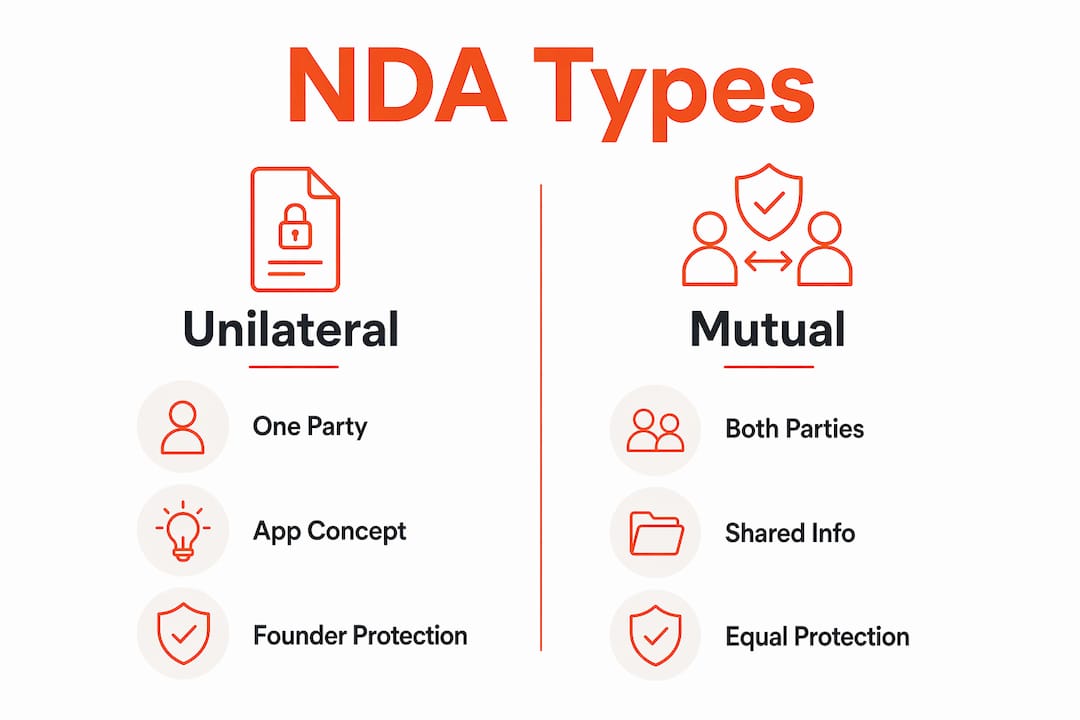
Multilateral agreements become necessary when your development team includes a primary agency plus subcontractors. If the agency passes your wireframes to a freelance designer without a separate NDA in place, your protection breaks down. A multilateral structure covers all parties under one document, which is cleaner and harder to circumvent.
Pro Tip: Review any NDA template your developer sends you before signing. Many agencies use their own standard agreements that favor their interests. Have an attorney or a legal consulting resource like Ventis Consulting review the terms before you commit.
Key clauses every app development NDA must include
A non-disclosure agreement without teeth is just a formality. These are the clauses that determine whether your agreement actually holds up:
- Definition of confidential information: Specific, not generic. List categories explicitly and state that oral disclosures are included.
- Permitted use restrictions: The receiving party may only use your information for the defined project. No repurposing, no sharing with third parties without written consent.
- Access controls: Limit who on the developer's team can view sensitive materials. Named individuals or defined roles only.
- Duration clause: NDAs commonly specify confidentiality periods of 2 to 5 years, with indefinite protection available for trade secrets. Distinguish between the agreement's term and the survival of obligations after the project ends.
- Remedies clause: Without explicit remedies, an NDA lacks legal deterrence. Specify injunctive relief, monetary damages, and attorney fee recovery as consequences of breach.
- Exclusions: Carve out information that is already public, independently developed, or disclosed through a third party without restriction. These exclusions protect the developer from unreasonable claims and make your agreement more enforceable.
- Governing law and jurisdiction: Specify which state's law applies and where disputes will be resolved. This matters enormously if you are working with an overseas development team.
- Digital signature validity: Digital signatures are legally valid and widely accepted in commercial agreements, so remote execution does not delay your project timeline.
Pro Tip: Add a data privacy overlay if your app will collect user data. Reference applicable regulations like GDPR or CCPA within the NDA so the developer is explicitly bound to compliance standards from day one, not just after launch.
When and how to use an NDA during app development
Timing is everything. Most confidentiality breaches happen not during active development but during the evaluation phase, when founders are pitching their concept to multiple vendors simultaneously.
- Before the first detailed conversation. Sign the NDA before sharing concepts, wireframes, or business models. A short introductory call to assess fit is acceptable without one, but the moment you describe your product in detail, the agreement must already be in place.
- Before sharing any documents. Pitch decks, feature specifications, and architecture diagrams should never be emailed without a signed agreement on file. Use a document management tool like DocuSign or PandaDoc to track execution before file transfer.
- Before onboarding subcontractors. If your primary developer uses freelancers or third-party services, require them to sign equivalent confidentiality agreements. Your NDA with the agency does not automatically extend to their subcontractors.
- Before discovery workshops. Structured planning sessions where you map out user flows, data models, and technical requirements are high-risk disclosure events. Treat them like code-sharing events from a legal standpoint.
- Alongside your MSA and IP assignment. An NDA covers confidentiality. A Master Services Agreement covers project scope, payment, and deliverables. An IP assignment transfers ownership of the code to you. All three documents work together. Relying on the NDA alone leaves ownership and scope unprotected.
Beyond the legal documents, limit access to sensitive materials on a need-to-know basis. Use private repositories, role-based permissions in project management tools like Jira or Notion, and watermarked documents for anything shared externally. Operational security measures complement your NDA by reducing the surface area for potential breaches before they happen.
What NDAs cannot do for your app idea
NDAs are powerful, but founders routinely overestimate what they cover. Understanding the limits prevents costly surprises.
- NDAs do not block independent development. If a developer independently creates a similar app without using your shared information, no breach occurs. The NDA only restricts use of what you disclosed.
- NDAs do not create trade secret status automatically. Under the Defend Trade Secrets Act, you must also demonstrate that you took reasonable steps to maintain secrecy. An NDA is evidence of those steps, not a substitute for them.
- Overly broad NDAs get rejected. Professional developers often push back against agreements that restrict their use of general coding knowledge or prior work. An NDA that tries to claim ownership of standard development practices will either be refused or struck down.
- NDAs are difficult to enforce across borders. If your developer is based in another country, enforcement depends on international agreements and local law. Jurisdiction clauses help, but litigation across borders is expensive and slow.
- Confidentiality alone does not protect ownership. Without a separate IP assignment agreement, a developer who signs your NDA may still legally own the code they write for you in some jurisdictions.
The practical takeaway: treat your NDA as one layer in a multi-layer protection strategy, not the entire strategy.
Key takeaways
A well-drafted app development NDA protects your source code, business strategy, and product roadmap by legally binding developers and partners to confidentiality before any sensitive information is shared.
| Point | Details |
|---|---|
| Sign before any disclosure | Execute the NDA before discovery calls, document sharing, or technical discussions begin. |
| Match NDA type to your situation | Use unilateral for solo disclosure, mutual when both sides share data, multilateral for teams with subcontractors. |
| Include a remedies clause | Without explicit breach consequences, your NDA lacks legal deterrence and may not hold up in court. |
| Combine with IP assignment and MSA | An NDA covers confidentiality only. Ownership and project scope require separate agreements. |
| Supplement with operational security | Limit access, use private repositories, and apply role-based permissions alongside your legal protections. |
Why I think most startup NDAs are written backwards
Most NDA templates I see are written to protect the developer, not the founder. They are broad on what the developer can keep doing with their "general knowledge" and narrow on what counts as your confidential information. Founders sign them because they want to move fast, and the agreement looks official enough.
The problem is that a generic template from a legal document site does not account for the specific risk profile of an app startup. Your competitive advantage is not just the code. It is the combination of your market insight, your user research, your pricing model, and your go-to-market timing. None of that shows up in a standard NDA unless you put it there.
What actually works is a short, specific agreement drafted around your actual disclosures. Name the categories. Name the project. Set a realistic duration. Add a remedies clause with real consequences. Then pair it with an IP assignment so you own what gets built.
I have also seen founders refuse to share NDAs because they worry it signals distrust. That instinct is wrong. Reputable developers expect NDAs. Any developer who resists a reasonable, balanced agreement is a developer worth walking away from. The NDA conversation is itself a filter for professionalism.
— Kaleb
Build your app with a team that takes confidentiality seriously
Protecting your app idea starts before the first line of code. At Maestroforge, every client engagement begins with clear confidentiality agreements and defined IP ownership. The team behind Maestroforge has helped Northwest Arkansas businesses like Ozark Freight Partners build custom applications that delivered measurable results, including a 40% reduction in operational calls. If you are ready to move from concept to working product with a development partner who treats your ideas with the same care you do, Maestroforge is built for exactly that kind of work.
FAQ
What is an app development NDA?
An app development NDA is a legally binding non-disclosure agreement that prevents developers, contractors, and partners from sharing or misusing your confidential app-related information, including source code, wireframes, and business strategy.
When should I sign an NDA with a developer?
Sign the NDA before sharing any detailed product information, including during discovery calls, design workshops, or document exchanges. Verbal assurances carry no legal weight.
What is the difference between a unilateral and mutual NDA?
A unilateral NDA protects one disclosing party, typically the founder. A mutual NDA applies when both parties share proprietary information, which is less common in standard startup-to-developer engagements.
How long does an app development NDA last?
Most NDAs specify confidentiality periods of 2 to 5 years, with indefinite protection possible for trade secrets. The agreement should distinguish between its active term and the survival of obligations after the project ends.
Can an NDA prevent someone from building a similar app?
No. An NDA only restricts use of information you specifically disclosed. If a developer independently builds a similar product without using your shared data, no breach occurs under the agreement.