
Craftsmanship in app development is defined as the deliberate, judgment-driven creation of software built to fit your specific business workflows, constraints, and competitive goals. Template apps, by contrast, are pre-built frameworks designed for the broadest possible audience. Understanding how craftsmanship differs from template apps is the decision that separates businesses running software that serves them from businesses serving their software. The stakes are real: maintenance and workarounds for template software can consume 60 to 80% of total lifecycle costs. That number alone reframes the "templates are cheaper" argument entirely.
How craftsmanship differs from template apps in practice
Software development alternates between two modes. The first is craft: creative, exploratory work applied when standard patterns don't fit unique organizational constraints. The second is trade: disciplined execution of established solutions for familiar problems. Authentication flows, payment processing, and basic dashboards are trade work. A custom carrier dispatch portal that integrates with your specific freight partners and reduces inbound calls by 40% is craft work. That distinction is the foundation of the entire craftsmanship vs template apps debate.
Craftsmanship in software means a developer applies creativity and judgment to problems where no existing pattern fully applies. Craft involves novel workflows, unusual domain constraints, and high-performance demands that off-the-shelf tools simply cannot address. Template apps, by definition, are built for trade-level problems. They assume your business operates like most businesses. When it does not, the mismatch creates friction from day one.

The industry term for what craftsmanship produces is bespoke software development. This phrase carries more precision than "custom app development" because it implies the software was designed around your exact specifications, not modified from a generic starting point. Bespoke solutions from firms like Maestroforge encode your actual workflows into the architecture, rather than asking you to adapt your operations to a vendor's assumptions.
Pro Tip: Map your three most operationally unique workflows before any development conversation. If a template app cannot replicate all three without workarounds, you are looking at a craft problem, not a trade problem.
Here are the clearest signals that your business need requires craftsmanship rather than a template:
- Your core workflow does not map cleanly to any existing SaaS platform's feature set
- You need deep integration with proprietary or legacy systems
- Regulatory or compliance requirements are specific to your industry or region
- Your competitive advantage depends on a process that competitors cannot easily replicate with the same tools
- You have tried a template solution and spent more time working around it than working with it
How template apps work and where they fall short
Template apps and low-code platforms deliver genuine value in specific contexts. They launch fast, cost less upfront, and handle standard business functions like invoicing, CRM, and project tracking with reasonable competence. For a business in its first year testing a market, a template app is often the right call. The problem is not that templates exist. The problem is staying on them past the point where they fit.
The operational friction begins when your business outgrows the template's assumptions. Using off-the-shelf templates forces workflows to adapt to software rather than the reverse, and that adaptation compounds over time. Every workaround your team builds around a template's limitations is a small tax on productivity. Across a team of ten people over two years, those taxes add up to a significant operational cost that never appears on the original vendor invoice.
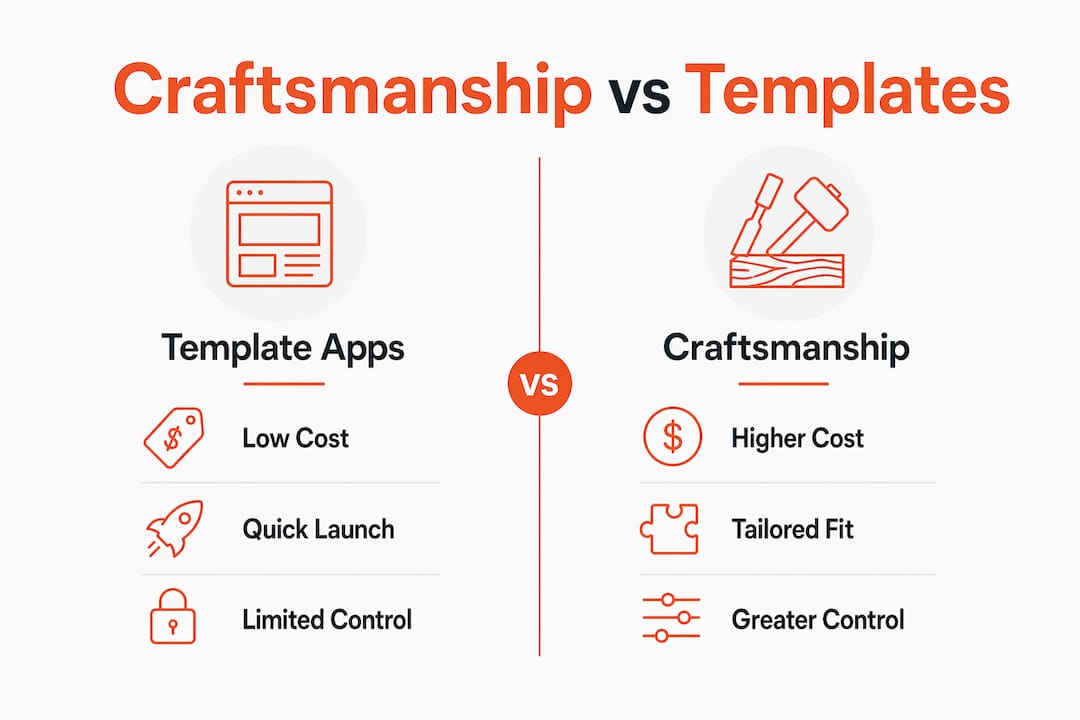
Low-code and template tools also trade maintainability for convenience, creating technical debt that complicates every future change. When your business needs a new feature, you are not just building something new. You are building it on top of a foundation that was never designed for your specific use case. That foundation pushes back.
The comparison below captures the core trade-offs business owners face:
| Factor | Template apps | Custom (bespoke) development |
|---|---|---|
| Initial cost | Low | Higher upfront investment |
| Time to launch | Days to weeks | Weeks to months |
| Workflow fit | Generic, requires adaptation | Built to your exact process |
| Integration depth | Limited, API-dependent | Architecture-level, proprietary |
| Long-term cost | High due to workarounds and debt | Lower when workflows are stable |
| Security and compliance | Vendor-defined, shared model | Custom-defined, business-specific |
| Scalability | Vendor roadmap controls limits | You control the roadmap |
| Competitive differentiation | None, competitors use same tools | High, proprietary capability |
The integration challenge deserves specific attention. Template apps connect to other systems through APIs, which works until it does not. When your ERP, your logistics platform, and your customer portal all need to share data in real time, API-based integrations between three separate template tools create fragility. One vendor update can break a workflow your entire operation depends on.
Craftsmanship vs template apps: a direct comparison for decision-making
The most practical way to evaluate your choice is to assess four dimensions: control, scalability, security, and long-term cost. Bespoke development aligns software tightly to workflows, integrates at the architecture level, and supports security and compliance models that generic SaaS platforms cannot match. Each of those advantages compounds as your business grows.
Control is the most underrated factor. With a template app, your feature roadmap is the vendor's feature roadmap. If the vendor decides to deprecate a feature, change pricing, or shut down entirely, your operations absorb that disruption. With a custom app, you own the codebase. You decide what gets built, when, and how. For businesses where software is a core operational asset, that control is not optional.
Custom crafted apps also form a strategic moat by enabling proprietary data structures and unique integrations that templates cannot replicate. This is the competitive advantage argument that most template vendors will never make for you. When your software encodes your unique process, competitors cannot simply buy the same tool and match your capability. That asymmetry is worth real money.
Pro Tip: Before committing to custom development, audit your existing integrations. If you are already paying for three or more template tools that partially overlap in function, the combined annual cost often exceeds a custom solution's build cost within 18 to 24 months.
The long-term cost picture also favors craftsmanship for businesses with stable, differentiated workflows. Consider these decision criteria:
- Choose a template app when your workflow is standard, your budget is constrained, and you need to launch within weeks to validate a market
- Choose bespoke development when your workflow is unique, integration depth matters, compliance requirements are specific, or your competitive advantage depends on proprietary software capability
- Reassess your template when workarounds consume more than 10% of your team's weekly time, or when a vendor change has disrupted your operations more than once in a year
Recognizing whether a developer truly understands your vision is also part of this decision. A developer who defaults to templates for every problem is a trade practitioner. You need a craft practitioner when your problem is genuinely novel.
Balancing craftsmanship and templates: hybrid approaches that work
Most mature businesses do not choose between craftsmanship and templates. They use both deliberately. Organizations often use hybrid models, applying template apps to standard workflows and custom modules where differentiation is critical. The key is knowing which category each part of your business falls into before you build anything.
A practical framework for implementing a hybrid approach:
- Audit your workflows by type. Separate standard processes (payroll, basic CRM, email) from differentiated ones (proprietary dispatch logic, custom pricing engines, unique client portals). Standard processes are candidates for template tools. Differentiated ones are candidates for craft.
- Calculate the true cost of your current templates. Add subscription fees, integration maintenance time, workaround labor, and any consultant fees paid to extend template functionality. Compare that total to a custom build estimate for the same capability.
- Identify your highest-friction points. The workflows where your team spends the most time working around software limitations are your highest-priority candidates for bespoke development.
- Allocate technical debt budget proactively. Practitioners recommend dedicating 15 to 20% of sprint capacity to paying down template-induced technical debt. If you are using templates in any part of your stack, budget for this explicitly or the debt will accumulate silently.
- Plan for modernization as a two-phase process. Understanding your legacy or template system is craft work. Rebuilding components on a custom foundation is trade work. They require different skills and different management approaches. Treat them separately in your project planning.
Managing long-term technical debt from mixed environments requires explicit agreements with your development partner about maintenance responsibilities and upgrade cycles. This is not a detail to negotiate after launch.
Key takeaways
Custom app development outperforms template apps for any business where workflows are unique, integration depth matters, or competitive advantage depends on proprietary software capability.
| Point | Details |
|---|---|
| Craftsmanship addresses novel problems | Use bespoke development when standard patterns cannot fit your specific domain constraints or workflows. |
| Templates carry hidden long-term costs | Maintenance and workarounds for template software can consume 60 to 80% of total software lifecycle costs. |
| Control and scalability favor custom builds | With bespoke software, you own the roadmap and are not subject to vendor decisions or deprecations. |
| Hybrid models optimize investment | Apply templates to standard processes and custom development only where differentiation is operationally critical. |
| Technical debt requires active management | Allocate 15 to 20% of development capacity to paying down template-induced debt before it limits velocity. |
Why I think the "templates are cheaper" argument misses the point
After working closely with businesses across Northwest Arkansas, the pattern I see most often is not a business that chose the wrong tool. It is a business that chose the right tool for year one and never revisited the decision in year three. Templates are genuinely excellent for validation. They are genuinely costly for operations that have matured past the point of generic fit.
Human-centric design and craftsmanship drive market preference for quality over volume in software, and that preference is accelerating as AI-generated template content floods every category. The businesses that will hold competitive ground are the ones whose software encodes something a competitor cannot simply license. That is not a philosophical argument. It is a structural one.
The uncomfortable truth I have learned is that most entrepreneurs underestimate how much of their competitive advantage lives in their operational processes. When those processes run on the same template tools every competitor uses, the advantage erodes. The craft-vs-trade distinction is not just a developer's concern. It is a business strategy question dressed in technical clothing.
— Kaleb
Build software that works the way your business works
Maestroforge builds custom web and mobile applications for Northwest Arkansas businesses that have outgrown generic templates. The team at Maestroforge applies a craft-first approach to every project, encoding your actual workflows into software architecture rather than bending your operations to fit a vendor's assumptions. Ozark Freight Partners reduced operational calls by 40% with a custom carrier portal built by Maestroforge. If your business has workflows that no template app handles cleanly, that is exactly the kind of problem Maestroforge was built to solve. Explore what a bespoke solution looks like for your operation.
FAQ
What is the core difference between craftsmanship and template apps?
Craftsmanship in app development applies creative judgment to novel business problems where standard patterns do not fit, while template apps execute pre-built solutions designed for common, generic workflows. The distinction determines whether your software serves your business or your business serves your software.
When does a template app make more sense than custom development?
Template apps make sense when your workflow is standard, your budget is limited, and you need to launch quickly to validate a market. The calculus shifts toward custom development once workarounds consume significant team time or when competitive advantage depends on a proprietary process.
How does technical debt from templates affect my business?
Template-driven development accumulates technical debt that complicates every future change, reducing maintainability and flexibility over time. Practitioners recommend allocating 15 to 20% of development capacity specifically to managing that debt before it limits your ability to grow.
Can I use both template apps and custom development together?
Yes. Hybrid models apply template tools to standard processes like payroll and basic CRM, while reserving custom development for workflows where differentiation is operationally critical. The key is auditing which parts of your business fall into each category before committing resources.
What makes bespoke software a competitive advantage?
Custom apps encode proprietary workflows and enable unique integrations that competitors cannot replicate by purchasing the same template tool. This creates a structural moat that compounds as your data and processes become more sophisticated over time.