
A change order in software development is a formal, documented modification to an agreed project scope, cost, or schedule that requires written approval before any work begins. Known formally as a scope change authorization in contract management, the change order sits at the intersection of legal protection and practical project control. Project managers, developers, and business analysts who skip this process expose their teams to billing disputes, scope creep, and broken client relationships. Tools like Jira, Confluence, and purpose-built contract platforms all support change order workflows, but the underlying discipline is process-driven, not tool-driven.
What is a change order in software, and what does it contain?
A standardized change order document contains six core sections: a unique tracking ID, a description of the modification, a business justification, an impact analysis on budget and schedule, a list of affected dependencies, and authorized signatures from all relevant stakeholders. Each element serves a specific function. The unique ID creates an audit trail. The justification forces the requester to articulate why the change is worth the cost. The impact analysis prevents teams from agreeing to work they have not fully priced.
Using templates for this structure improves clarity and approval speed significantly compared to ad-hoc requests. Without a template, project managers often receive vague verbal requests that morph into undocumented work. A one-page standardized form eliminates that ambiguity before it starts.

Pro Tip: Build your change order template directly into your project kickoff package. When clients sign the original contract, they also sign off on the change order format, which removes friction when the first modification request arrives.
Here is what each section of a well-structured change order should accomplish:
- Unique ID: Enables tracking across Jira tickets, contract logs, and invoices without confusion
- Description of work: States precisely what is being added, removed, or modified
- Business justification: Documents why the change is necessary, protecting both parties in a dispute
- Budget and schedule impact: Quantifies additional hours, costs, and revised delivery dates
- Affected dependencies: Flags downstream features, integrations, or testing cycles that will shift
- Authorized signatures: Confirms mutual agreement before a single line of code changes
The signatures section deserves special attention. Formal documentation with signed approvals creates a complete audit trail that protects both the development team and the client from disputes later. No signature means no authorization, full stop.
How does a change order differ from a contract amendment?
A change order handles tactical, project-level modifications within the existing contract framework. A contract amendment rewrites or replaces core terms of the original agreement itself. Misusing these two documents creates legal and audit risks that can surface months after a project closes.
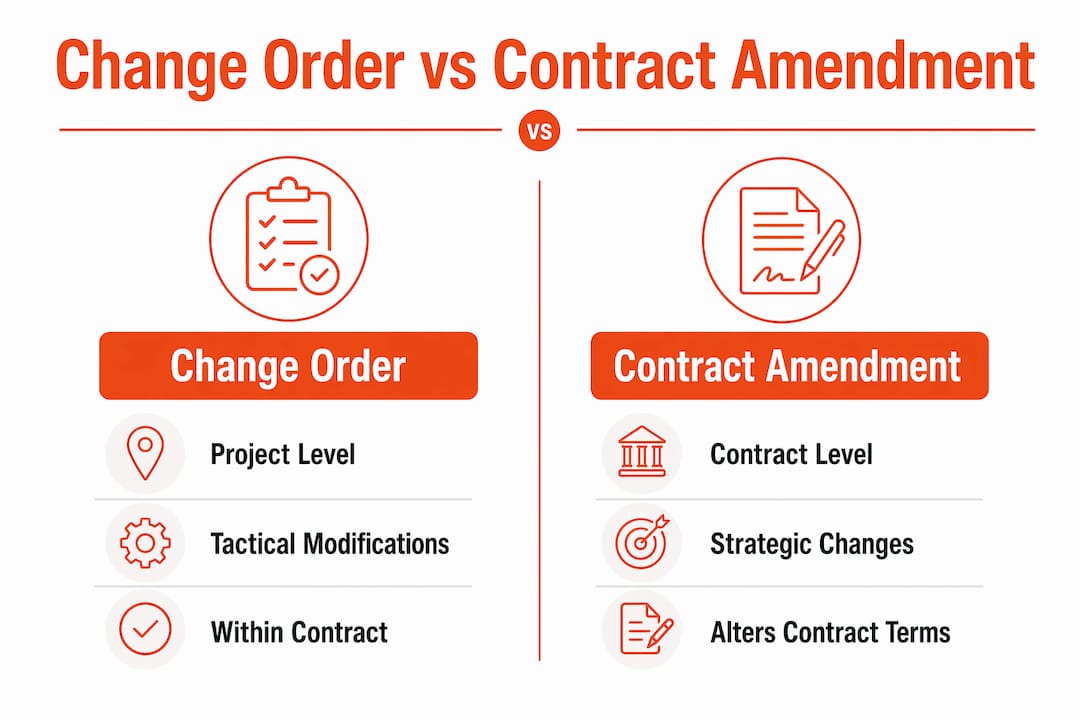
The distinction matters practically. If a client wants to add a new reporting dashboard to an existing web application, that is a change order. If the same client wants to change the payment structure from fixed-price to time-and-materials, that requires a contract amendment. Treating the second scenario as a simple change order leaves the original payment terms legally intact while the project operates under different assumptions.
A change request is a third, related document that often gets conflated with the other two. The change request is the initial proposal submitted by a stakeholder before any formal review. It becomes a change order only after impact analysis and approval. Think of the change request as the intake form and the change order as the signed authorization.
- Change request: Informal or semi-formal proposal, no binding authority
- Change order: Formally approved modification with cost and schedule impact confirmed
- Contract amendment: Rewrites fundamental contract terms, requires legal review
Pro Tip: Add a one-paragraph "Document Hierarchy" section to every software contract you sign. Define exactly when a change request escalates to a change order and when a change order escalates to a contract amendment. This single paragraph prevents most document-type disputes.
What is the recommended process for managing change orders?
Effective change order management follows a defined sequence that removes ambiguity at every stage. Designating who can request changes is the first and most overlooked step. When multiple stakeholders can submit requests independently, development teams receive conflicting demands and waste time resolving internal client politics instead of building software.
A practical change order process for software projects looks like this:
- Designate authorized requesters. Limit change requests to one or two named individuals on the client side. This single point of contact prevents contradictory instructions.
- Submit a written change request. The requester documents the proposed modification using the agreed template. Verbal requests do not enter the queue.
- Conduct a formal impact assessment. The development team evaluates cost, schedule, and dependency effects within a defined window. Best-practice workflows mandate approval within 3 to 10 business days, depending on technical complexity. This timeline keeps projects moving without forcing rushed decisions.
- Present the change order for approval. Both parties review the impact assessment, negotiate if needed, and sign the finalized document.
- Update the project log. The signed change order enters the centralized change log with its unique ID, revised budget figures, and updated delivery milestones.
- Adjust acceptance testing criteria. Late major changes may extend acceptance periods or require entirely new testing rounds. The change order should explicitly state whether acceptance criteria change.
- Begin work. Not before step six. Never before step six.
Some agreements include a contingency budget for minor changes, allowing streamlined approvals below a set dollar threshold. This prevents project paralysis over small requests while maintaining formal governance for significant modifications. A threshold of $500 to $2,000 is common in mid-market software contracts.
Pro Tip: Establish your change order process during contract negotiation, not after the first dispute. Negotiating procedures upfront removes emotional tension from what would otherwise become a charged conversation mid-project.
What are common pitfalls when handling software change orders?
The most expensive mistake in software change order management is the phantom change. A phantom change starts when a developer acts on a verbal request from a client contact before any written approval exists. Starting work on verbal requests creates unrecoverable financial risk. The client denies authorizing the work. The developer has no signed document. The hours are absorbed as a loss.
The second most common pitfall is conflating defect fixes with scope changes. A defect is a failure to meet the original specification. It does not generate a change order and should not incur additional charges. A scope change adds functionality or modifies requirements beyond what was originally specified. Clear contractual definitions prevent disputes about whether a reported issue is a bug or a new feature request. Without that clarity, every bug report becomes a negotiation.
Other pitfalls that consistently derail projects include:
- Ignoring ripple effects: Change order costs include not only immediate developer time but also impacts on testing cycles, dependent features, and overall project momentum. A two-day coding change can trigger a two-week testing delay.
- Unclear approval authority: When clients have no designated approver, change orders circulate indefinitely. Projects stall while internal client teams debate priorities.
- Missing documentation: Teams that rely on email threads instead of signed documents lose their legal standing when disputes arise. Email is evidence of a conversation, not evidence of authorization.
"Without formal documentation, ambiguity arises about agreed changes, risking disputes and scope creep that neither party can easily resolve after the fact." — Zycus Change Order Glossary
How do change orders impact project success and client relationships?
A well-managed change order process protects both buyer and supplier by creating shared clarity on what was agreed, what it costs, and when it will be delivered. This transparency converts what could be a contentious conversation into a straightforward business transaction. Clients who understand the process trust the team more, not less, because they see that modifications are handled professionally rather than absorbed silently and billed ambiguously.
Change orders also enable genuine flexibility. Software requirements evolve as businesses learn more about their users. A rigid contract that cannot accommodate change forces clients into workarounds or drives them to competitors. A formal change order process gives both parties a structured way to adapt without abandoning the original agreement. The project stays on track financially while the product evolves to meet real needs.
From a reporting standpoint, a complete change order log gives project managers accurate data on scope growth over time. If a project accumulates ten change orders before launch, that pattern signals either unclear initial requirements or a client who needs more discovery work upfront. Both insights improve how the team scopes future projects.
Pro Tip: Send clients a monthly change order summary showing all approved modifications, their cumulative cost impact, and the revised delivery timeline. This single report prevents end-of-project billing surprises and reinforces your team's professionalism.
For teams managing IT project delivery, embedding change order reviews into regular sprint retrospectives keeps the process visible and prevents backlogs of unreviewed requests from accumulating.
Key takeaways
A change order in software is only as effective as the process and documentation discipline behind it. Teams that enforce written approvals before work begins protect their budgets, their timelines, and their client relationships simultaneously.
| Point | Details |
|---|---|
| Define before you build | Establish the change order process and document hierarchy during contract negotiation, not mid-project. |
| Six-section structure | Every change order needs a unique ID, description, justification, impact analysis, dependencies, and signatures. |
| No signature, no code | Starting work without written approval creates unrecoverable financial risk and eliminates legal standing. |
| Defects are not change orders | Bug fixes that address original spec failures should never generate additional charges or change order paperwork. |
| Log everything | A centralized change order log with signed documents reduces dispute risk and improves future project scoping. |
Why the "no signature, no code" rule is the only rule that matters
I have reviewed dozens of software project disputes, and the pattern is almost always the same. A developer is friendly, accommodating, and eager to help. A client makes a casual request in a Slack message. The developer says "sure, I can knock that out." Three weeks later, the invoice arrives with unrecognized line items, and the relationship fractures.
The "no signature, no code" rule is not bureaucratic rigidity. It is the single clearest protection a development team has. I have seen teams lose thousands of dollars on phantom changes that were genuinely well-intentioned. The client believed the work was included. The developer believed it was authorized. Neither was right, and neither had documentation to prove their position.
What I advocate for is negotiating the entire change order process before the project starts, not as a defensive measure but as a sign of professionalism. Clients who understand the process upfront rarely push back on it mid-project. They actually appreciate the structure because it protects them too. A signed change order means they cannot be billed for work they did not approve.
The teams that struggle most with change orders are the ones who treat the process as an obstacle to getting things done. The teams that thrive treat it as a communication tool. Every signed change order is a shared record of a decision both parties made together. That record is worth more than any amount of goodwill built on informal agreements.
— Kaleb
How Maestroforge handles change orders so you never get surprised
Maestroforge builds change order management directly into every project engagement. From the first discovery call, clients receive a clear document hierarchy, a defined approval process, and a centralized change log that updates in real time. When Ozark Freight Partners needed modifications to their custom carrier portal mid-build, the change order process kept the project on budget and on schedule, contributing to the 40% reduction in operational calls they achieved at launch. If you are looking for a development partner who treats project governance as seriously as the code itself, explore Maestroforge's approach to custom web and mobile applications built for Northwest Arkansas businesses.
FAQ
What is a change order in software development?
A change order in software development is a formally documented modification to an existing project's scope, cost, or schedule that requires written approval from authorized stakeholders before implementation begins.
How is a change order different from a change request?
A change request is the initial proposal submitted by a stakeholder before any formal review. It becomes a change order only after an impact assessment is completed and both parties sign off on the revised terms.
What happens if work starts without a signed change order?
Starting work without written approval creates what practitioners call a "phantom change," which carries unrecoverable financial risk. Without a signed document, neither party has legal standing to enforce the agreed terms.
Do defect fixes require a change order?
No. Defect fixes address failures to meet the original specification and should not generate a change order or additional charges. A change order applies only when new functionality or modified requirements go beyond the original agreed scope.
How long should a change order approval take?
Best-practice workflows require formal approval within 3 to 10 business days, depending on the technical complexity of the modification. Setting this timeline in the original contract prevents indefinite delays and keeps projects moving.