
A load board is an online marketplace where freight brokers, shippers, and carriers post available loads and truck capacity to match shipments with the right equipment quickly. The industry standard term is "freight load board," though most professionals simply say "load board." Platforms like DAT and Truckstop dominate the US market, giving carriers and brokers real-time access to thousands of spot market opportunities every day. Understanding what is a load board explained correctly separates drivers who run profitable miles from those chasing deadhead.
What is a load board and how does it work?
A load board is, at its core, a searchable database. Brokers and shippers post freight with fields covering origin, destination, equipment type, weight, per-mile rate, pickup date, and delivery window. Carriers log in, filter by lane and equipment, and either book instantly or negotiate directly with the poster.
The workflow follows a predictable sequence:
- Create an account and complete onboarding. Carriers register with their MC number, insurance certificates, and operating authority. Brokers verify this data before approving carrier packets.
- Post a load or search available freight. Brokers post loads with full details. Carriers search by lane, equipment, and rate. Load boards support truck postings too, where carriers signal available capacity or backhaul opportunities to attract inbound offers.
- Filter and evaluate. Most platforms let you filter by miles, rate per mile, equipment type, and pickup date. Review the full posting carefully before reaching out.
- Book or negotiate. Some loads offer a "Book Now" button for instant confirmation. Others require a phone call or email to agree on rate and terms.
- Execute the freight move. Once booked, carriers manage the bill of lading (BOL), proof of delivery (POD), and any accessorial documentation through the platform or directly with the broker.
- Invoice and collect payment. Submit your paperwork and invoice. Most platforms display payment terms upfront.
Pro Tip: Set automated alerts for your preferred lanes before you finish your current load. The best spot market freight disappears within minutes on platforms like DAT, and alerts give you a head start on competitors still searching manually.
What are the benefits of load boards for carriers and brokers?

Load boards reduce deadhead miles and accelerate load matching in ways that phone-based freight brokerage never could. Automated alerts and instant booking keep trucks moving instead of sitting at a truck stop waiting for a callback.
The core benefits break down clearly:
- Reduced empty miles. Carriers returning from a delivery can search backhaul loads in the destination market before they even unload, cutting unpaid miles significantly.
- Price discovery. Load boards function as price-discovery infrastructure for the spot market, surfacing real-time rate data by lane so carriers know whether a posted rate is fair or below market.
- Speed for owner-operators. New entrants with a single truck can find their first load on DAT or Truckstop the same day they receive operating authority, without needing an established broker network.
- Operational flexibility. Carriers can shift lanes, equipment types, or regions based on where rates are strongest, something impossible without real-time load visibility.
- Broker efficiency. Freight brokers post a load once and receive carrier inquiries within minutes instead of cold-calling carriers to cover freight.
Pro Tip: Do not evaluate a load on rate per mile alone. Factor in deadhead miles to the pickup, fuel stops, appointment windows, and accessorial charges. A load paying $2.80 per mile with 150 miles of deadhead often earns less than a $2.50 load sitting two miles from your current position.
Load boards vs. freight marketplaces: what is the real difference?
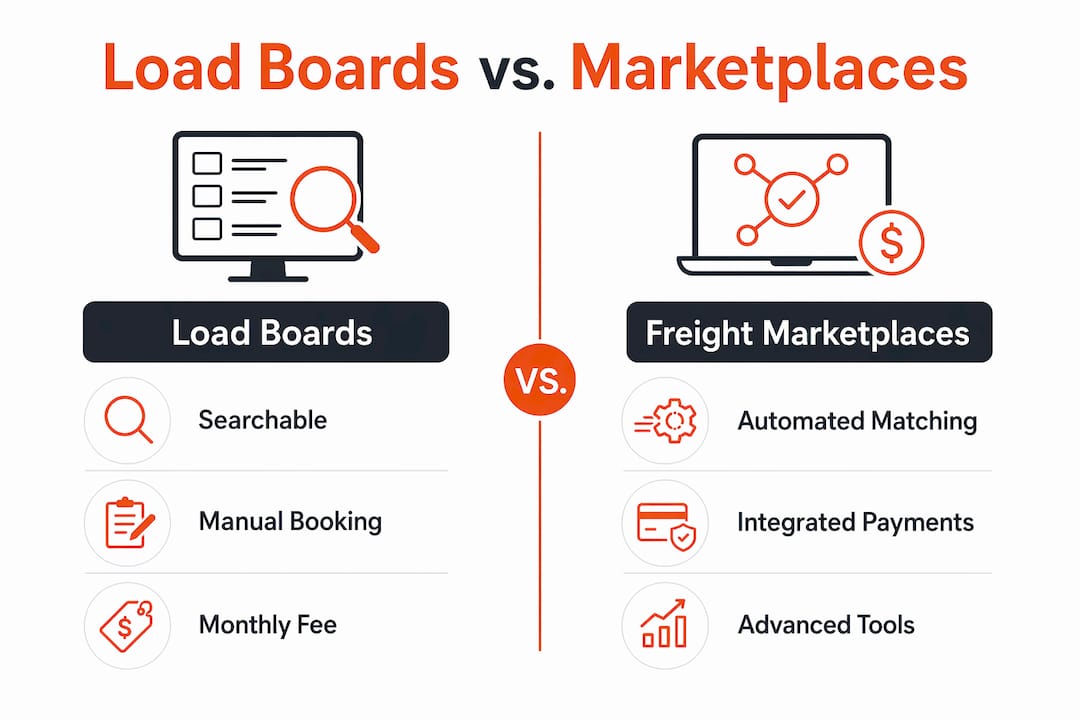
Load boards and freight marketplaces are not the same thing, though the terms get used interchangeably. Load boards are searchable databases built for manual search and booking. Freight marketplaces layer automated matching, integrated tracking, digital documentation, and sometimes payment processing on top of that foundation.
| Feature | Load board | Freight marketplace |
|---|---|---|
| Load search and filtering | Yes | Yes |
| Automated carrier matching | No | Yes |
| Integrated BOL/POD tools | Rarely | Common |
| Real-time shipment tracking | Limited | Standard |
| Payment and factoring integration | Some platforms | Common |
| Workflow automation | Minimal | Core feature |
The practical implication is straightforward. A carrier running spot freight on DAT uses a load board: they search, call, negotiate, and book manually. A carrier integrated into a freight marketplace like Convoy (before its closure) or a shipper's proprietary portal receives automated load offers, digital paperwork, and payment without manual back-and-forth. For brokers, digital freight tools that handle BOL and POD digitally reduce administrative overhead and speed up carrier payment cycles.
Choosing between the two depends on your volume and tech tolerance. High-volume carriers benefit from marketplace automation. Smaller operators or those who prefer relationship-based booking often find traditional load boards more flexible and less restrictive.
Key features and tools of leading load boards in the US
The four most widely used load boards in the US are DAT, Truckstop, 123Loadboard, and Trucker Path Pro. Each targets a slightly different segment of the market.
Major platforms like DAT and Truckstop charge subscriptions ranging from $40 to $200 per month depending on the tier. DAT's higher tiers include rate analytics and credit scoring for brokers. Truckstop offers carrier onboarding tools and broker credit checks. 123Loadboard targets owner-operators with a lower price point and a strong mobile app. Trucker Path Pro combines load searching with a truck stop and weigh station database, which is genuinely useful for route planning.
Key features worth evaluating across any platform:
- Rate visibility. Does the platform show average rates per lane, not just posted rates? DAT's rate analytics tool is one of the most referenced in the industry.
- Mobile app quality. Drivers need to search and book from the cab. Weak mobile apps cost time.
- Factoring integration. Platforms that connect directly to factoring companies like OTR Solutions or RTS Financial let carriers get paid in 24 to 48 hours instead of waiting the typical 21 to 30 days that most broker payment terms require.
- Truck posting capability. Posting your available capacity signals your position to brokers actively looking for coverage, which inverts the search dynamic in your favor.
- API access. Larger fleets and brokerages use API integrations to pull load data directly into their transportation management systems (TMS), eliminating manual data entry entirely.
Key takeaways
A load board is the foundational tool for spot market freight matching, and using it profitably requires understanding rate data, payment terms, and broker vetting, not just finding available loads.
| Point | Details |
|---|---|
| Core load board definition | An online marketplace where brokers post freight and carriers search by lane, rate, and equipment type. |
| Workflow sequence | Account setup, load search or truck posting, booking, freight execution, and invoicing follow a defined order. |
| Load boards vs. marketplaces | Load boards are manual search tools; freight marketplaces add automation, tracking, and integrated payments. |
| Payment terms matter | Most brokers pay in 21 to 30 days; factoring integration on platforms like DAT or Truckstop accelerates cash flow. |
| Profitability beyond rate | Deadhead miles, accessorial charges, and broker credit scores determine actual load value, not posted rate alone. |
Why most carriers use load boards wrong
I have watched carriers, including experienced ones, treat a load board like a job board. They search, see a rate, call the broker, and book. That is the entire process in their mind. It is also why many of them run tight margins or worse.
The carriers who actually profit from load boards use them as operational tools with internal cost models. They know their cost per mile before they open the app. They know which lanes pay well in which direction and at what time of month. When they see a posted rate, they are not asking "is this good?" They are asking "does this beat my floor by enough to justify the appointment window and the deadhead?"
The other mistake I see constantly is skipping broker vetting. Broker credit and days-to-pay data are displayed on most platforms for a reason. Two loads at $2.60 per mile are not equal if one broker pays in 14 days and the other pays in 45. Cash flow is an operational constraint, not a finance department problem.
New carriers also get tripped up by onboarding. Booking is often blocked until a broker approves your carrier packet, which can take hours or days. Set up your packets with your top five brokers before you need a load, not while you are sitting empty at a shipper dock.
The load board is not the strategy. It is the tool. The strategy is knowing your numbers, vetting your counterparties, and using automation to move faster than the next carrier on the same lane.
— Kaleb
How Maestroforge helps logistics teams get more from their tools
If you run a freight brokerage or carrier operation in Northwest Arkansas and your team is still copying load details between a load board and a spreadsheet, that gap is costing you real money. Maestroforge builds custom web and mobile apps that connect directly to your existing workflows, including load board data, document management, and carrier communication, without the overhead of enterprise software.
Ozark Freight Partners reduced operational calls by 40% after Maestroforge built a custom carrier portal that automated the back-and-forth that load boards alone cannot handle. If your operation has outgrown generic tools, Maestroforge delivers purpose-built solutions on a timeline that matches how fast freight moves. Visit maestroforge.dev to see what a tailored approach looks like for your business.
FAQ
What is a load board in trucking?
A load board is an online platform where freight brokers and shippers post available loads and carriers search for freight matching their equipment and lane preferences. Platforms like DAT and Truckstop are the most widely used in the US.
How do load boards make money?
Load boards charge carriers and brokers monthly subscription fees, typically ranging from $40 to $200 per month depending on the platform and feature tier.
What is the difference between a load board and a freight marketplace?
A load board is a searchable database requiring manual search and booking. A freight marketplace adds automated matching, integrated tracking, digital documentation, and payment tools on top of that foundation.
Do owner-operators need a load board subscription?
Owner-operators benefit significantly from load board subscriptions because they provide direct access to spot market freight without requiring an established broker network or dedicated dispatch service.
What should I check before booking a load?
Check the broker's credit score, days-to-pay terms, total loaded miles, deadhead to pickup, and any accessorial requirements before confirming. Rate per mile alone does not determine whether a load is worth taking.