
Most business leaders assume AI lowers development costs simply by making developers code faster. That framing misses the real story. Understanding why AI-augmented development lowers costs requires looking beyond raw speed to the engineering systems underneath. What the industry calls AI-augmented development, or AI-assisted software engineering, delivers sustainable savings when it amplifies mature workflows, not when it patches over broken ones. This article breaks down the actual mechanisms, the measurement traps to avoid, and the strategic moves that separate leaders who see real returns from those who just see bigger AI bills.
Table of Contents
- Key Takeaways
- Why AI-augmented development lowers costs as a multiplier
- Workflow redesign is where the real savings live
- Measuring net savings without fooling yourself
- AI in operational contexts: what real savings look like
- My take on what actually drives sustainable AI savings
- How Maestroforge builds AI cost efficiency into every project
- FAQ
Key Takeaways
| Point | Details |
|---|---|
| AI multiplies what's already there | Organizations with mature DevOps and CI/CD workflows see the largest AI-driven cost reductions. |
| Process redesign drives most savings | 70% of AI cost value comes from redesigning workflows, not from automation alone. |
| Measure net savings, not gross speed | True cost reduction AI requires accounting for licensing, integration, and oversight costs before claiming savings. |
| Stabilization takes time | Allow 3 to 6 months after AI deployment before measuring reliable net savings to avoid inflated pilot numbers. |
| Real-world results are substantial | AI-driven development savings like Air India's 50% call volume reduction show what full integration can achieve. |
Why AI-augmented development lowers costs as a multiplier
The most important thing to understand about AI in software development is that it does not create value from nothing. AI improves delivery performance only as a multiplier of existing engineering conditions. The DORA 2025 report, drawing from nearly 5,000 professionals, found that organizations with mature platform capabilities benefit most from AI adoption. Those without that foundation often see costs rise, not fall, because AI accelerates the complexity already present in their systems.
Think of it this way. If your CI/CD pipeline is fragile, your deployment processes are manual, and your code review culture is inconsistent, adding AI tooling speeds up the rate at which those problems compound. You ship more code faster, and more of it breaks in production. That is not cost reduction. That is cost amplification.
The flip side is genuinely compelling. Power users of AI tools showed 14x higher commit activity and produced 4x more test code compared to non-AI users, according to GitKraken's analysis of 2,172 developer-weeks. Regular AI users demonstrate approximately 25% higher output compared to their own performance a year prior. When those gains land in a stable engineering environment, the cost per delivered feature drops significantly.
Here is what strong engineering conditions look like in practice:
- Automated testing coverage above 70%, so AI-generated code gets validated before it ships
- Mature CI/CD pipelines that catch integration failures within minutes, not days
- Clear code ownership and review processes that prevent AI-generated shortcuts from accumulating as technical debt
- Platform engineering teams that abstract infrastructure complexity away from product developers
Pro Tip: Before investing in AI tooling, run a DORA metrics baseline on your engineering team. If your change failure rate is above 15% or your mean time to recovery exceeds a day, fix those first. AI will magnify whatever number you start with.
Workflow redesign is where the real savings live
Here is the number that should reshape how you think about AI cost efficiency: 70% of AI cost reduction value comes from redesigning workflows and processes, not from automation alone. BCG's 2026 research makes this point directly. Dropping an AI tool into an existing process captures maybe 30% of the available value. Redesigning the process around what AI can do autonomously captures the rest.
This distinction matters enormously for how you sequence your investments. Here is a practical framework for prioritization:
- Start with your most mature workflows. These are the processes where steps are well-defined, outputs are measurable, and failures are caught quickly. AI performs best where the rules are clear. Early wins here generate savings you can reinvest.
- Map the handoffs. Most process waste lives at the boundaries between humans and systems. AI-driven development savings compound when you eliminate unnecessary handoffs rather than just speeding up each individual step.
- Introduce agentic AI for high-volume repetitive tasks. Agentic AI, which operates autonomously within defined parameters, delivers the largest per-task cost reductions in areas like code review, test generation, and deployment validation.
- Use early savings to fund deeper redesign. The BCG framework specifically recommends this sequencing. Quick wins in mature workflows fund the harder work of end-to-end process reinvention in more complex areas.
- Measure cycle time, not just individual task speed. A developer who codes 40% faster but waits two days for a code review has not reduced your cost per feature. System-level throughput is the metric that connects to actual savings.
The organizations that treat AI as an add-on to existing processes capture incremental gains. Those that redesign work around AI's capabilities create a structural cost advantage that compounds over time.
Pro Tip: Identify one high-volume, well-documented internal process, such as onboarding new API integrations or running regression tests, and redesign it end-to-end with AI in mind before scaling to other areas. A focused redesign beats ten shallow automations.

Measuring net savings without fooling yourself
This is where many AI cost reduction stories fall apart. A pilot shows 40% faster development cycles. Leadership declares victory. Six months later, the actual cost savings are nowhere near what the pilot projected. The reason is almost always the same: the measurement excluded the real costs of running AI at scale.
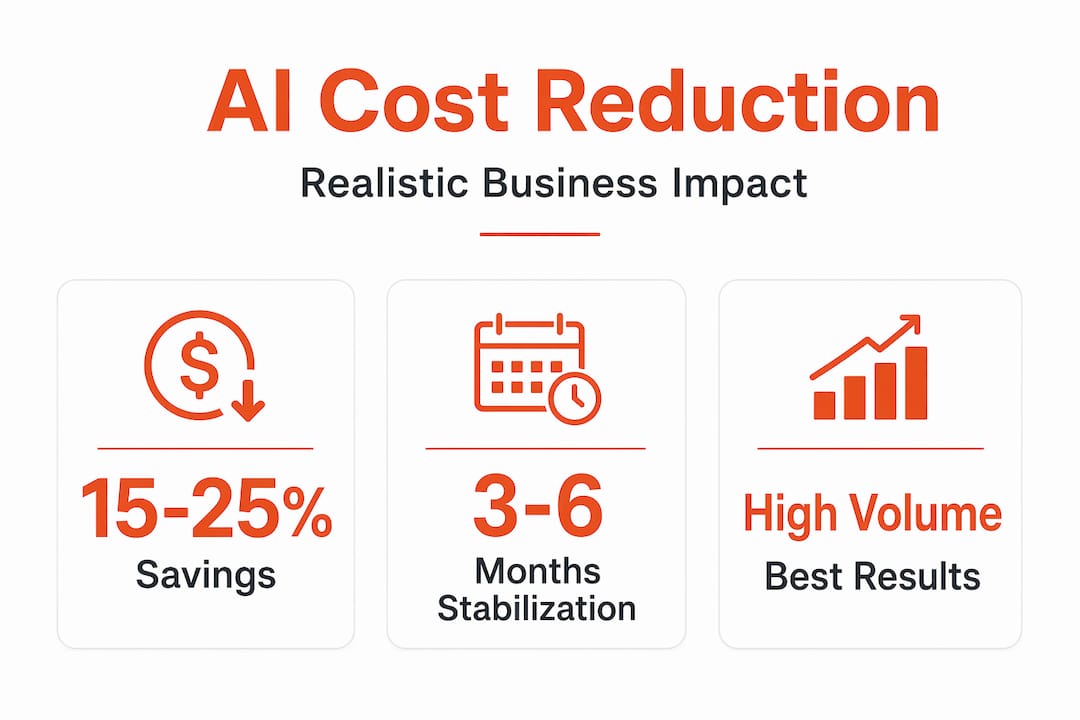
Realistic AI cost savings range from 15 to 25% net after accounting for total cost of ownership. Opagio's framework makes clear what gets left out of most savings calculations.
| Cost category | What gets missed | Why it matters |
|---|---|---|
| AI licensing | Per-seat or usage-based fees at scale | Pilot costs rarely reflect production volume |
| Integration and maintenance | Ongoing API updates, model version changes | These grow as AI usage expands |
| Human oversight | Prompt engineering, exception handling | Hidden AI costs inflate net savings claims |
| Stabilization period | 3 to 6 months of reduced productivity | Teams need time to adapt workflows |
| Infrastructure | Compute, monitoring, incident response | Often absorbed by IT without attribution |
The stabilization window deserves particular attention. When a team adopts new AI tools, productivity often dips before it rises. Developers learn new workflows, prompting patterns change, and integration bugs surface. Measuring savings during this window produces numbers that look terrible. Measuring only after it produces numbers that look inflated. The honest approach is to wait for the 3 to 6 month mark and measure from there.
For business leaders, the practical advice is straightforward. Build a cost tracking model before you deploy, not after. Include every line item above. Set a measurement start date that accounts for stabilization. Then compare against that baseline consistently.
AI in operational contexts: what real savings look like
The clearest examples of how AI lowers expenses come from operational deployments where volume is high and tasks are repetitive. Contact centers are the most documented case. Enterprises deploying autonomous AI agents in contact centers achieve 15 to 30% cost reductions over 12 to 24 months by automating high-volume tasks and improving metrics like handle time, attrition, and compliance rates.
Air India's results are even more striking. The airline built 30+ in-house AI tools and realized Rs 100 crore in annual savings, with chatbots alone cutting call center volumes by 50%. That is not a productivity improvement. That is a structural reduction in operating expenses achieved through AI-augmented development of internal tools.
What made Air India's approach work mirrors the principles above:
- They built custom tools rather than deploying generic solutions, which meant AI fit their actual workflows
- They targeted high-volume, repetitive interactions first, where containment rates are measurable
- They tracked operational metrics like call volume and handle time, not just development speed
- They integrated AI into decision workflows, not just customer-facing chat
The impact of AI on costs in these environments comes from compounding effects. Lower call volume reduces labor costs. Better containment reduces error rates. Reduced attrition lowers training costs. Each metric feeds the next. That compounding dynamic is why the 12 to 24 month window matters. The savings build over time as AI handles more volume and human teams shift toward higher-value work.
My take on what actually drives sustainable AI savings
I've watched businesses chase AI cost savings by focusing almost entirely on developer velocity. Faster commits, shorter sprint cycles, more features per quarter. It sounds right. It rarely delivers what the spreadsheet promises.
What I've found is that the organizations realizing genuine, durable cost reductions share one characteristic: they treated AI adoption as an organizational change project, not a tooling upgrade. They asked hard questions about process maturity before they wrote a single AI license check. They redesigned workflows before they measured outcomes. And they were honest about the stabilization period instead of cherry-picking pilot data.
The uncomfortable truth is that tracking only developer speed metrics can mislead cost expectations. InfoQ's coverage of the DORA findings puts it plainly: AI accelerates complexity in immature environments. I've seen this firsthand. A team that ships twice as fast but accumulates technical debt at three times the rate is not saving money. It is borrowing against future engineering capacity.
My advice to any leader evaluating AI-driven development savings: fund the workflow redesign work explicitly. Don't treat it as a side project that happens alongside normal delivery. Give it a budget, a timeline, and an owner. The teams that do this are the ones who look back in 18 months and can actually point to where the savings came from.
— Kaleb
How Maestroforge builds AI cost efficiency into every project
If the principles in this article resonate, the question becomes how to apply them without building an internal AI engineering practice from scratch.
Maestroforge specializes in custom web and mobile apps built with AI augmentation baked into the development process, not bolted on afterward. The team's approach mirrors what BCG and DORA research confirm: mature workflows, disciplined measurement, and process design that captures real AI development benefits rather than just speed metrics. Ozark Freight Partners saw a 40% reduction in operational calls after Maestroforge delivered a custom carrier portal, a result that came from redesigning the workflow, not just building a faster version of what existed before. For Northwest Arkansas businesses that need tailored solutions with genuine AI cost efficiency, Maestroforge offers the combination of local context and technical depth that generic development firms cannot match.
FAQ
What makes AI-augmented development different from regular software development?
AI-augmented development integrates AI tools directly into the engineering workflow, from code generation and testing to deployment validation. The key difference is that AI acts as a multiplier on developer output rather than replacing the developer, with mature DevOps environments seeing the largest productivity and cost gains.
How long before AI development investments show real cost savings?
Most organizations need 3 to 6 months of stabilization after AI deployment before savings measurements are reliable. Opagio's research shows net savings typically land between 15 and 25% once all costs, including licensing, integration, and oversight, are factored in.
Why do some companies see AI increase costs instead of reduce them?
AI amplifies existing engineering conditions, which means weak processes get worse faster. Organizations without mature CI/CD pipelines, clear code ownership, or automated testing often see technical debt accumulate more quickly when AI accelerates their output.
What types of workflows benefit most from AI-driven cost reduction?
High-volume, well-documented, repetitive workflows see the fastest and largest cost reductions. Contact center automation and internal tool development are two of the most documented examples, with autonomous AI agents delivering 15 to 30% cost reductions over 12 to 24 months in those environments.
Should business leaders prioritize AI tooling or workflow redesign first?
Workflow redesign should come first, or at minimum run in parallel with tooling adoption. BCG's research shows that redesigning processes accounts for 70% of the total cost value AI delivers, making it the higher-leverage investment for leaders focused on sustainable savings.