
Dedicated developers are full-time software professionals committed exclusively to your project, and they represent the most direct path to faster delivery, lower costs, and sustained product quality for entrepreneurs building software in 2026. The shift away from in-house hiring is driven by scarce senior talent, high recruitment costs, and long ramp times, making the dedicated development team model a lower-risk alternative for startups at every stage. Understanding why entrepreneurs need dedicated developers means understanding how this model outperforms freelancers, fixed-scope agencies, and traditional hiring on nearly every operational metric. Gartner and CloudDevs data both confirm that speed and cost efficiency are the two factors founders cite most when switching models.
Why entrepreneurs need dedicated developers: the model explained
A dedicated development team is a group of software professionals, including developers, QA engineers, and sometimes a project manager, who work exclusively on your product under your direction. They are not shared across client accounts like agency staff, and they are not scoped to a single deliverable like freelancers. They integrate into your workflows, attend your sprint ceremonies, and build domain knowledge over time.
The contrast with other models is stark. In-house hiring for senior developers takes 12 to 20 weeks, while dedicated development vendors can deploy teams within 2 to 4 weeks, often with first code commits in 48 hours. That gap represents months of lost product development for a startup operating on a tight runway.

Freelancers offer speed but not continuity. A freelancer finishes a contract and moves on, taking institutional knowledge with them. Fixed-scope outsourcing locks you into a defined deliverable, which breaks down the moment your product roadmap evolves. Dedicated teams sit in a different category entirely: they scale with you, adapt to new priorities, and deepen their understanding of your product over time.
| Model | Onboarding time | Cost structure | Continuity | Flexibility |
|---|---|---|---|---|
| In-house hiring | 12 to 20 weeks | Salary + benefits + overhead | High | Low |
| Freelancers | 1 to 2 weeks | Per project or hourly | Low | Medium |
| Fixed-scope agency | 2 to 4 weeks | Fixed contract | Low | Very low |
| Dedicated team | 2 to 4 weeks | Monthly retainer | High | High |
The dedicated model wins on the combination of speed, continuity, and adaptability. No other model delivers all three simultaneously.
What are the primary benefits of hiring dedicated developers?
The benefits of dedicated developers fall into four categories that directly address what entrepreneurs lose sleep over: time, money, quality, and capacity.
-
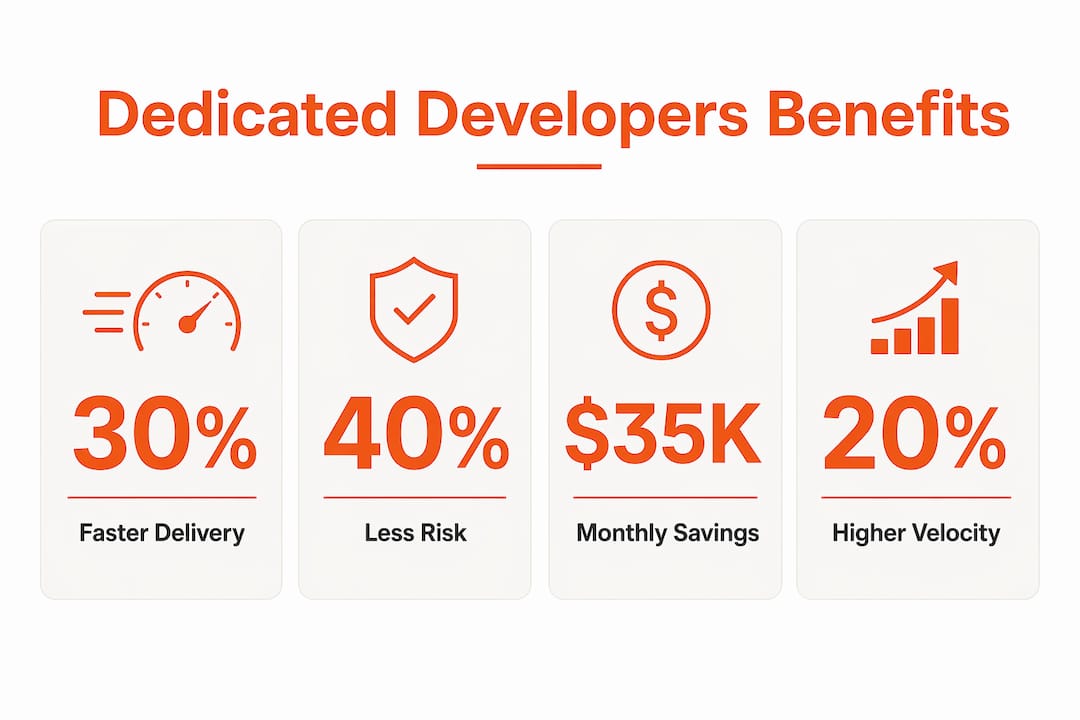
Speed to market. Companies using dedicated development teams report 30% to 50% faster delivery compared to traditional hiring or outsourcing. That acceleration comes from reduced recruitment delays and stronger domain knowledge retention. For a startup racing to beat a competitor to launch, that difference is not incremental. It is existential.
-
Cost efficiency. Hiring dedicated developers instead of building an in-house team saves example startups $30,000 to $42,000 monthly on a five-person pod, extending runway by six months with no equity dilution. Mid-level dedicated developers cost $4,000 to $8,000 per month, and senior developers run $7,000 to $12,000, representing a 30% to 50% lower total cost of ownership versus in-house equivalents when you factor out office leases, hardware, and benefits.
-
Flexibility and scale. You can add a mobile specialist for a new feature sprint and release them when the work is done. No severance, no HR process, no months-long search. This elasticity is what makes dedicated teams particularly well-suited for startups whose product scope shifts with market feedback.
-
Quality and continuity. Dedicated developers build deep familiarity with your codebase, your users, and your technical constraints. Over time, they evolve from code executors into strategic partners who proactively improve product quality and technical solutions through that deep product alignment. That kind of institutional knowledge is impossible to replicate with rotating freelancers.
Pro Tip: Runway extension from dedicated developers is often overlooked in cost comparisons. Six months of additional runway without giving up equity can be the difference between reaching product-market fit and running out of capital.
How do you maximize the value of a dedicated development team?
Hiring a dedicated team is the first step. Getting real value from them requires operational discipline on your end.
The most important structural decision is assigning an internal product manager as the primary liaison between your business and the development team. This person owns knowledge transfer, maintains product vision coherence, and prevents the communication gaps that kill remote collaborations. Without this role filled, even the best developers will build the wrong thing.
Communication tooling matters more than most founders expect. Unified communication tools and overlapping time zones can boost sprint velocity by up to 35%. That means choosing teams whose working hours overlap with yours by at least four hours, and standardizing on tools like Jira, Slack, and Confluence from day one rather than letting each side use their preferred stack.
Vendor vetting is where most entrepreneurs underinvest. Proper vendor vetting reduces project failure rates by up to 40%, and carefully vetted teams deliver 25% to 35% faster than ad-hoc freelancer teams on projects lasting over six months. Vetting should include technical assessments, reference checks with past clients, and a paid trial sprint before any long-term commitment. The importance of talent vetting for tech startups cannot be overstated: a bad hire in a dedicated model costs you weeks of lost velocity, not just a failed task.
Pro Tip: Run a two-week paid discovery sprint before signing a long-term contract. You will learn more about a team's communication style, code quality, and problem-solving approach in two weeks of real work than in any interview process.
Additional practices that separate high-performing dedicated team engagements from mediocre ones:
- Set clear KPIs from week one: velocity targets, bug rates, and deployment frequency
- Require the team to operate within your Agile cycles, not their own
- Schedule weekly retrospectives that include both your internal staff and the dedicated team
- Define escalation paths for blockers so issues surface in hours, not days
- Review contract essentials and IP ownership terms before any code is written
How do dedicated developers support long-term product growth?
Short-term freelancers solve immediate problems. Dedicated developers build products. That distinction matters more as your startup matures and your technical architecture grows in complexity.
Dedicated teams achieve 20% to 30% higher velocity on complex, long-term projects due to reduced context switching and accumulated domain knowledge. A developer who has worked on your platform for 12 months understands why certain architectural decisions were made, where the technical debt lives, and how new features will interact with existing systems. A new freelancer starts at zero every time.
This knowledge retention also supports product evolution. As your roadmap shifts from MVP to growth features to enterprise capabilities, a dedicated team adapts without the ramp-up cost of re-onboarding. They can access specialized skills in areas like AI integration, cloud-native architecture, and mobile performance optimization, either within the team or through their vendor's extended network.
| Growth stage | Freelancer fit | Dedicated team fit |
|---|---|---|
| Pre-MVP prototype | High | Medium |
| MVP to launch | Medium | High |
| Post-launch iteration | Low | Very high |
| Scale and enterprise features | Very low | Very high |
The lean product development principle of building, measuring, and learning fast depends on a team that can iterate without losing context between cycles. Dedicated developers are structurally built for that loop. Freelancers are not.
What myths and pitfalls should entrepreneurs avoid?
The most common mistake entrepreneurs make with dedicated developers is treating them like external vendors rather than integrated team members. When a dedicated team is kept at arm's length, communication degrades, alignment breaks down, and the product suffers. They need access to your product roadmap, your user research, and your strategic priorities.
Watch out for vendors who hide their developers behind account managers. You should have direct access to the engineers building your product. If a vendor insists on filtering all communication through a sales or project management layer, that is a red flag for transparency and accountability.
Other pitfalls to avoid:
- Signing long-term contracts without a trial period or performance benchmarks
- Skipping NDA and IP assignment agreements. Review what startups need to know about NDAs before any code is written
- Assuming cultural alignment without testing it. Communication styles, work ethics, and feedback norms vary significantly across regions
- Failing to define who owns the codebase, documentation, and deployment credentials from day one
- Treating the engagement as purely transactional rather than investing in relationship-building with the team
Vendor transparency and the ability to replace poor fits quickly are critical to project success. Build that expectation into your contract from the start.
Key takeaways
Dedicated developers are the highest-leverage hiring decision an entrepreneur can make when building software products that need to ship fast, evolve continuously, and stay within budget.
| Point | Details |
|---|---|
| Speed advantage | Dedicated teams onboard in 2 to 4 weeks versus 12 to 20 weeks for in-house hiring. |
| Cost savings | A five-person dedicated pod saves $30,000 to $42,000 monthly compared to in-house equivalents. |
| Long-term velocity | Dedicated teams achieve 20% to 30% higher velocity on complex projects through domain knowledge retention. |
| Vendor vetting matters | Proper vetting reduces project failure rates by up to 40% and improves delivery speed significantly. |
| Integration is the differentiator | Teams that operate inside your Agile cycles and use your tools outperform siloed external vendors. |
What I've learned about dedicated developers that most articles won't tell you
Most articles frame dedicated developers as a cost-saving measure. That framing is accurate but incomplete, and it leads entrepreneurs to optimize for the wrong things.
The founders I have seen get the most out of dedicated teams are not the ones who found the cheapest monthly rate. They are the ones who treated the engagement like a leadership challenge rather than a procurement decision. They assigned strong internal product managers, ran disciplined sprint reviews, and gave the team real ownership over technical decisions within defined boundaries.
The runway extension argument is real, but it is secondary to the velocity argument. Saving $35,000 a month matters. Shipping a feature in three weeks instead of three months matters more. In competitive markets, speed is the asset that compounds. A dedicated team that deeply understands your product ships faster every month they stay on it, while a rotating cast of freelancers resets that clock constantly.
I also think entrepreneurs underestimate how much developer alignment with your vision affects output quality. A developer who understands what you are building and why will make better micro-decisions every day than one executing instructions without context. That is not a soft benefit. It shows up in code quality, architecture choices, and the number of rework cycles you run.
The shift to dedicated teams in 2026 is not a trend. It is a structural response to a market where senior talent is scarce, recruitment is expensive, and product cycles are short. Entrepreneurs who recognize that early will build better products faster than those still trying to hire full-time engineers in a 20-week cycle.
— Kaleb
Build faster with Maestroforge's dedicated development team
Maestroforge builds custom web and mobile applications for entrepreneurs and businesses in Northwest Arkansas who need more than a generic template. The team operates as a small, dedicated unit focused on craftsmanship and rapid deployment, using an AI-augmented development process that cuts delivery time without cutting corners. Ozark Freight Partners reduced operational calls by 40% after Maestroforge built a custom carrier portal tailored to their exact workflow. If you are ready to stop waiting on slow hiring cycles and start shipping product, explore what Maestroforge builds and see how a dedicated team approach can accelerate your next project.
FAQ
What is a dedicated development team?
A dedicated development team is a group of software professionals who work exclusively on your project under your direction, integrated into your workflows and Agile cycles rather than shared across multiple client accounts.
How much do dedicated developers cost compared to in-house hiring?
Mid-level dedicated developers cost $4,000 to $8,000 per month and senior developers run $7,000 to $12,000, representing 30% to 50% lower total cost of ownership versus in-house equivalents when overhead is factored in.
How fast can a dedicated team start delivering?
Dedicated development vendors typically deploy teams within 2 to 4 weeks, with first code commits often happening within 48 hours of engagement, compared to 12 to 20 weeks for traditional in-house hiring.
Are dedicated developers better than freelancers for startups?
For projects lasting more than six months, dedicated developers outperform freelancers significantly. Vetted dedicated teams deliver 25% to 35% faster and carry domain knowledge that freelancers lose at the end of each contract.
What is the biggest mistake entrepreneurs make with dedicated teams?
Treating dedicated developers as external vendors rather than integrated team members is the most common failure point. Teams that operate inside your product roadmap, sprint cycles, and communication tools consistently outperform those kept at arm's length.