
The discovery phase in app development is defined as the structured planning stage where stakeholders align on vision, requirements, and technical constraints before a single line of code is written. The role of discovery phase in app projects is to replace assumptions with validated decisions, giving project managers, entrepreneurs, and developers a shared foundation that guides every subsequent stage of app development. Only 16.2% of software projects finish on time and within budget. Unclear requirements and misaligned expectations cause most of those failures. Discovery is the direct fix.
What is the role of discovery phase in app projects?
The discovery phase, sometimes called a project scoping phase or pre-development audit, is the first formal stage of any serious app project. It exists to answer one question before money is committed to development: does everyone agree on what is being built, why it matters, and how it will work? Without that answer, you are funding guesswork.
A thorough discovery phase involves stakeholder workshops, user research, competitive analysis, technical feasibility assessments, and roadmap building. Each of those activities produces something concrete. Stakeholder workshops surface conflicting priorities before they become expensive change requests. User research replaces founder assumptions with real behavioral data. Competitive analysis identifies gaps your app can fill rather than features already commoditized by existing tools.

The deliverables are equally specific. A well-conducted discovery phase produces wireframes, functional requirements documents, a risk register, technical architecture diagrams, and detailed project estimates. These artifacts are not bureaucratic paperwork. They are the decision-making tools your team will reference every week during development.
Pro Tip: Treat the discovery phase as a low-cost trial of your development partner. A firm that challenges your assumptions, asks hard questions, and delivers organized artifacts during discovery will behave the same way throughout the full build.
The discovery phase also serves as a risk-management anchor for the entire project. When requirements shift mid-build, the original discovery scope becomes the reference point for negotiating changes. That structure prevents the chaotic, undocumented change requests that derail timelines and inflate budgets.
Why does the discovery phase determine project success?
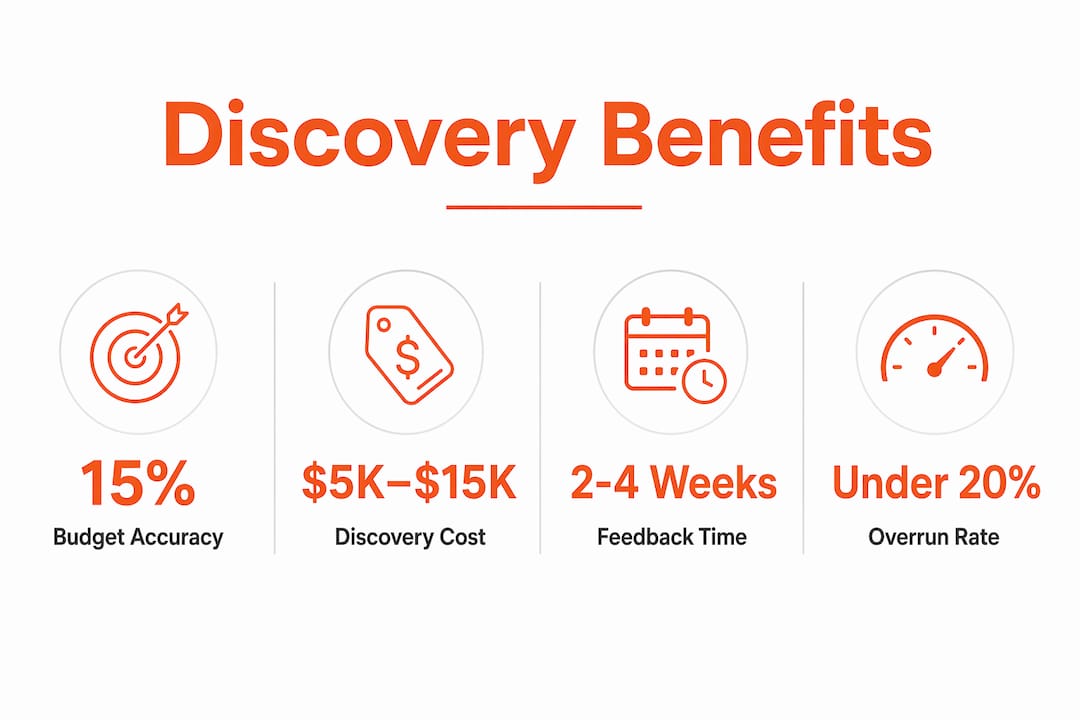
Budget overruns are the most measurable consequence of skipping discovery. Projects that skip the discovery phase average budget overruns of 189%, while those that invest in it typically keep overruns under 20%. That gap is not a coincidence. It reflects the cost of building features nobody asked for, reworking architecture that was never properly planned, and resolving stakeholder disagreements that should have been settled in week one.
"Discovery is the phase where business context, technical reality, and human workflows converge. Skip it, and you are building on assumptions instead of evidence." — Code Galaxy
Discovery also replaces assumptions with shared understanding, blending business context, technical reality, and user workflows in one structured conversation. That shared understanding is what prevents the most common failure mode in app projects: two teams building toward different definitions of success.
Many founders treat discovery as optional overhead. It is not. It is the mechanism that ensures the product you build is the product your users actually need. The Standish Group's research on software project failure consistently points to requirements problems as the root cause. Discovery is the only stage designed specifically to solve that problem before it costs you six figures.
Properly executed discovery also results in a smaller, more focused first build. That focus reduces technical complexity, accelerates learning from real users, and avoids the feature bloat that makes apps expensive to maintain. A leaner scope built on validated requirements outperforms a sprawling scope built on assumptions every time.
Discovery vs. skipping it: what the numbers show
The practical difference between running a discovery phase and skipping it shows up in three areas: cost, time, and quality of the final product.
| Metric | With Discovery | Without Discovery |
|---|---|---|
| Budget accuracy | Within 15% of estimate | 200%–300% overrun common |
| Time to first usable feedback | 2–4 weeks | 3–6 months |
| Rework cost | $5,000–$15,000 (discovery cost) | $50,000–$200,000 in rework |
| Scope creep risk | Low, anchored to documented requirements | High, driven by undocumented assumptions |
| Stakeholder alignment | Established before development | Negotiated during development |
Skipping discovery leads to major rework costing $50,000–$200,000, whereas a discovery phase costs $5,000–$15,000 with problems caught early. The math is straightforward. You pay a fraction of the potential rework cost upfront, or you pay the full rework cost after the damage is done.
The time difference is equally significant. Discovery cuts time to first usable feedback from 3–6 months down to 2–4 weeks. That acceleration matters because early feedback shapes better products. When you wait six months to learn that a core feature does not match user behavior, you have already built on a flawed foundation. When you learn it in week three, you adjust the wireframe.
Teams that skip discovery also face a compounding problem: scope creep. Without documented requirements, every stakeholder request feels equally valid. There is no baseline to push back against. Discovery creates that baseline, and it gives project managers a defensible framework for evaluating new requests against original goals.
How to conduct the discovery phase effectively
Running a discovery phase well requires structure, not just good intentions. Here is how to do it right.
-
Engage all key stakeholders from day one. Include product owners, developers, end users, and business decision-makers in the first workshops. Decisions made without one of these groups will be revisited later at higher cost.
-
Conduct real user research. Surveys and interviews with actual users produce personas grounded in behavior, not assumptions. Those personas drive feature prioritization throughout development.
-
Run a competitive analysis. Map what existing tools do well and where they fall short. Your app's differentiation should be visible in the discovery output, not discovered during launch.
-
Assess technical feasibility early. Have your development team evaluate architecture options, integration requirements, and platform constraints before committing to a feature list. Technical surprises mid-build are expensive.
-
Build testable prototypes or wireframes. Static wireframes are useful. Clickable prototypes are better. Early feedback on a prototype costs almost nothing compared to feedback on a built feature.
-
Budget discovery as a separate fixed-price phase. Discovery phase duration typically runs 2–6 weeks depending on project scope. Pricing it separately protects both client and agency from scope ambiguity and sets a professional tone for the engagement.
Pro Tip: Avoid the trap of treating discovery as a checkbox. If your discovery phase produces a document nobody references during development, it failed. Every artifact should be actively used in sprint planning, design reviews, and stakeholder updates.
The most common mistake teams make is rushing discovery to get to "the real work." Development is not the real work. Building the right thing is the real work. Discovery is where you figure out what that is. Investing $5,000–$15,000 in discovery is basic risk management for any project over $100,000. The return on that investment is a development process that runs on validated decisions instead of educated guesses.
For entrepreneurs specifically, discovery is also the moment to validate whether your app idea has a viable path to market. A well-structured MVP approach pairs naturally with discovery because both disciplines force you to define the smallest version of your product that delivers real value. Discovery tells you what to build first. An MVP strategy tells you how to build it without overcommitting resources.
Key takeaways
The discovery phase is the single most cost-effective investment in any app project because it prevents expensive rework, aligns stakeholders, and produces the validated requirements that make development predictable.
| Point | Details |
|---|---|
| Discovery prevents budget overruns | Projects with discovery keep overruns under 20%; those without average 189% over budget. |
| Deliverables drive development | Wireframes, risk registers, and architecture docs produced in discovery guide every sprint. |
| Early feedback saves money | Discovery cuts time to first usable feedback from months to weeks, reducing costly late-stage changes. |
| Budget discovery separately | A fixed-price discovery phase of 2–6 weeks protects both client and developer from scope ambiguity. |
| Skipping it is not free | Rework from skipped discovery costs $50,000–$200,000, far exceeding the $5,000–$15,000 discovery investment. |
Why discovery is the phase i refuse to skip
I have worked on enough app projects to know where things go wrong. It is almost never in development. It is in the conversation that did not happen before development started.
The most expensive project I have seen was not the one with the biggest budget. It was the one where a founder and a development team spent four months building toward two different definitions of "done." Neither party was dishonest. They just never sat in the same room and worked through the details. A proper discovery phase would have surfaced that misalignment in week one for a fraction of the cost.
What I find most valuable about discovery is not the documents it produces. It is the shared ownership it creates. When a project manager, a developer, and a business owner have all contributed to a requirements document and signed off on wireframes, they are all accountable to the same plan. That accountability changes how teams behave when things get hard, and things always get hard.
The other thing discovery does that nobody talks about enough: it tells you what not to build. The features that get cut during discovery are features that would have been built, tested, and eventually removed at full development cost. Cutting them in week two costs nothing. Cutting them in month five costs everything.
If you are evaluating a development partner and they do not propose a discovery phase, that tells you something important about how they understand your vision. The best firms treat discovery as non-negotiable because they know what happens when it is skipped.
— Kaleb
How Maestroforge structures discovery for app projects
Maestroforge builds every custom app engagement around a structured discovery phase before development begins. For project managers and entrepreneurs in Northwest Arkansas and beyond, that means you get wireframes, functional requirements, and a realistic project estimate before committing to a full build. Ozark Freight Partners went through this process and ended up with a custom carrier portal that cut operational calls by 40%. That result did not happen by accident. It happened because the right questions were asked and answered before the first line of code was written. If you are planning a web or mobile app, start with custom app development built on a foundation that actually holds.
FAQ
What is the discovery phase in app development?
The discovery phase is the structured pre-development stage where stakeholders define requirements, validate assumptions, and produce deliverables like wireframes and architecture plans. It runs 2–6 weeks depending on project scope.
How much does a discovery phase cost?
A typical discovery phase costs $5,000–$15,000. That investment is basic risk management for any app project over $100,000, given that skipped discovery leads to rework costs of $50,000–$200,000.
What deliverables come out of the discovery phase?
Discovery produces wireframes, functional requirements documents, user personas, a risk register, technical architecture diagrams, and detailed project estimates. These artifacts guide every stage of development.
Can you skip the discovery phase on a small app project?
Skipping discovery on any project increases the risk of scope creep, budget overruns, and misaligned stakeholder expectations. Even small projects benefit from a condensed discovery process to align requirements before development starts.
How does discovery phase differ from project planning?
Discovery is a collaborative research and validation process involving users, stakeholders, and technical teams. Project planning organizes tasks and timelines after requirements are already defined. Discovery comes first and informs the plan.