
A minimum viable product (MVP) is defined as the simplest version of a product that tests a core business assumption with real users before significant investment is made. Eric Ries, who formalized the lean startup methodology, built this concept around one principle: validated learning costs less than building the wrong thing. Startups build MVPs first because 35% of startups fail due to no market need. That single statistic explains the entire economic rationale. Zappos, Uber, and Dropbox all launched with stripped-down versions of their eventual products, not because they lacked resources, but because they understood that testing beats assuming.
Why startups build MVPs first: the core benefits
The MVP approach is not about shipping something cheap. It is about spending the minimum amount necessary to answer the most expensive question: does anyone actually want this?
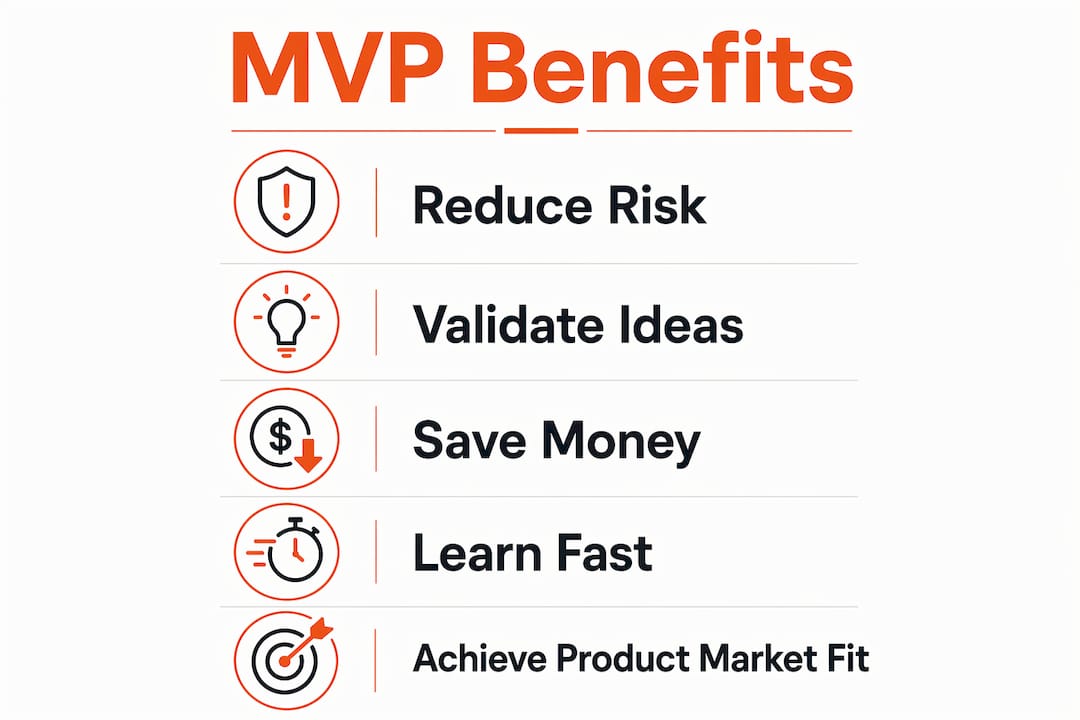
Reducing financial risk is the most immediate benefit. Atlassian frames MVP as the simplest version a team can launch quickly to gather real user feedback and guide future development. This means founders avoid committing months of engineering time and capital to features users may never use.

Accelerating validated learning is the second major advantage. Real user behavior tells you more in two weeks than six months of internal debate. When Zappos founder Nick Swinmurn photographed shoes from local stores and listed them online before building any inventory system, he learned within days that people would buy shoes on the internet. That single test replaced an assumption that would have cost millions to validate the wrong way.
The benefits of MVPs extend further:
- Focused development: Teams build only what solves the core user pain point, which reduces scope creep and keeps early products coherent.
- Early investor confidence: A working MVP with real user data is far more persuasive to investors than a pitch deck with projections.
- Faster product-market fit: Continuous feedback and feature refinement through Agile iteration means each version of the product is measurably closer to what users need.
"The goal of an MVP is not to build a small product. It is to maximize validated learning about customers with the least effort." — Eric Ries, The Lean Startup
Startups that skip the MVP stage often discover their product-market fit problem after spending $500,000 instead of $5,000. The MVP compresses that feedback loop to weeks, not years.
How does an MVP function as a hypothesis test?
The most important reframe for any founder is this: an MVP is not a prototype, and it is not a polished v1.0. It is a falsifiable experiment. Yu-kai Chou emphasizes that an MVP should test a specific hypothesis while ignoring cosmetic aspects entirely.
There are three layers of hypotheses every product contains:
- Core hypothesis: Does the fundamental problem exist, and will people pay to solve it? This is the only hypothesis worth testing first.
- Feature hypothesis: Does this specific feature solve the problem better than alternatives? Test this after the core is validated.
- Polish hypothesis: Does a better user interface increase retention or conversion? Test this last, once you know the product has a reason to exist.
Most founders get this order wrong. They spend weeks perfecting the interface before confirming anyone wants the product. The economic logic is clear: the cost of running the MVP test must be less than the cost of being wrong about the assumption. A landing page that costs $200 to build and tests whether users will sign up for a waitlist is a better first experiment than a $40,000 app that tests the same thing.
Pro Tip: Write your core hypothesis as a single falsifiable sentence before writing a single line of code. "We believe that [user type] will [take this action] because [this reason]." If you cannot write that sentence, you are not ready to build.
The difference between a prototype and an MVP is measurement. A prototype demonstrates functionality. An MVP generates data. Dropbox's explainer video was technically neither a product nor a prototype. It was a measurement device that collected 75,000 email signups overnight, proving demand before a single line of backend code existed.
What MVP formats do startups actually use?
MVP formats vary widely, and the right format depends entirely on which assumption carries the most risk. Zappos' photo-and-ship model validated demand without complex software. Uber's earliest version ran on SMS. Neither required a sophisticated technical build.
| MVP Format | Best for testing | Cost and speed |
|---|---|---|
| Landing page with signup | Demand and willingness to wait | Very low cost, days to build |
| Concierge (manual backend) | Whether the service delivers real value | Low cost, immediate feedback |
| Video demo (like Dropbox) | Demand before product exists | Low cost, fast to produce |
| Wizard of Oz (fake automation) | Whether users want automated experience | Medium cost, weeks to build |
| Single-feature app | Core functionality value | Higher cost, weeks to months |
Choosing the wrong format wastes time and money. A founder testing whether users want a logistics app should not build the app first. A concierge MVP, where the founder manually handles requests via email or phone, tests the same assumption at a fraction of the cost. Ozark Freight Partners, a Northwest Arkansas logistics company, validated their carrier communication needs through manual processes before committing to a custom portal build.
Pro Tip: Before choosing your MVP format, write down your single riskiest assumption. Then ask: what is the cheapest artifact that produces a clean yes or no answer to that assumption? That artifact is your MVP.
No-code tools like Webflow, Bubble, and Airtable have made landing page and concierge MVPs accessible to non-technical founders. Operationalizing the learning loop, meaning defining what to measure, how to collect feedback, and how to interpret it, is what separates a useful MVP from a vague soft launch. Set your success metric before you launch, not after you see the results.
What pitfalls kill MVP effectiveness?
The most common MVP mistake is building it to full-product quality standards. Christian Strunk highlights that this inflates timelines and shifts the team's psychology from learning to sunk-cost justification. When a team spends three months on an MVP, they stop treating it as an experiment and start defending it as a product.
Other pitfalls that consistently derail MVP-first strategies:
- Testing the wrong assumption: Many founders test feature preferences or design aesthetics before confirming the core business assumption. Startup Science shows that MVP effectiveness depends on challenging assumptions, not confirming them.
- Vanity metrics over commitment signals: 500 signups means nothing if none convert to paying customers. Measure actions that require real commitment: purchases, referrals, repeated use.
- No defined success criteria: An MVP without a pre-defined pass/fail threshold is not an experiment. It is a launch with no accountability. Define success before you build.
- Skipping structured feedback loops: Collecting user data without a system to interpret and act on it produces noise, not insight.
- Staying in MVP mode too long: Some founders use "we're still validating" as a reason to avoid building the full product. Once the core hypothesis is confirmed, the MVP has done its job. Move forward.
The dedicated developer relationship matters here too. Founders who work with developers who understand MVP discipline avoid the trap of over-engineering early versions. The goal is a clean measurement, not a polished product.
Key takeaways
Startups build MVPs first because validated learning is always cheaper than building the wrong product at full scale.
| Point | Details |
|---|---|
| MVP is a hypothesis test | Define one falsifiable core assumption and build the cheapest artifact that tests it. |
| Format follows assumption | Choose landing pages, concierge models, or video demos based on your riskiest unknown. |
| Measure commitment, not interest | Track purchases, signups with payment, or repeated use. Ignore vanity metrics. |
| Define success before building | Set a binary pass/fail threshold before launch to keep the experiment honest. |
| Move past MVP once validated | Staying in MVP mode after validation wastes the momentum the test created. |
The discipline most founders skip
I have worked with enough early-stage founders to know that the hardest part of MVP-first is not the build. It is the honesty. Most founders already believe their idea works before they test it. The MVP is supposed to challenge that belief, not confirm it. When results come back negative or ambiguous, the temptation is to explain away the data rather than update the hypothesis.
The founders who get this right treat their MVP the way a scientist treats an experiment. They write the hypothesis down. They define what a failed result looks like. And when the data says no, they pivot or stop. That last part, stopping, is something almost no startup advice prepares you for. But knowing when to stop is exactly what makes the MVP process valuable. It saves you from spending two years and $300,000 on a product nobody wants.
The other thing I have seen consistently: the quality of your early adopter community determines the quality of your MVP feedback. A hundred users who genuinely care about the problem give you more signal than ten thousand passive signups. Invest in finding the right early users, not just any users. Engage them directly. Ask uncomfortable questions. The feedback that stings is usually the feedback that matters.
MVP discipline is not a phase you graduate from. The best product teams apply the same hypothesis-first thinking to every major feature decision, even after the product is fully launched. That mindset is what separates companies that keep improving from companies that coast on early success.
— Kaleb
Build your MVP the right way with Maestroforge
Maestroforge builds custom web and mobile applications for startups and growing businesses in Northwest Arkansas, applying Agile and MVP-first methodology from day one. The team's AI-augmented development approach accelerates delivery without inflating scope, so you get a clean, testable product faster. Ozark Freight Partners reduced operational calls by 40% after Maestroforge built a custom carrier portal tailored to their actual workflow, not a generic template. If you are ready to test your core assumption with a purpose-built MVP, start with Maestroforge and avoid the costly mistakes that come from building before validating.
FAQ
What does MVP stand for in startups?
MVP stands for Minimum Viable Product. It is the simplest version of a product that tests a core business assumption with real users before significant resources are committed.
Why create an MVP instead of building the full product?
35% of startups fail due to no market need. An MVP tests whether that need exists at minimal cost, before a full product investment is made.
What is the difference between an MVP and a prototype?
A prototype demonstrates how a product works. An MVP generates measurable data about whether users want the product, making it a learning instrument rather than a demonstration tool.
How do you know if your MVP succeeded?
Success requires a pre-defined metric set before launch. A pass/fail threshold, such as 100 paid signups or a 20% conversion rate, defines success criteria and keeps the experiment honest.
Can non-technical founders build an MVP?
Yes. Concierge MVPs, landing pages built with Webflow, and video demos like Dropbox's original launch require no engineering. The format should match the riskiest assumption, not the founder's technical skill level.