
Post-launch support agreement planning is the process of building a structured framework that governs software maintenance, incident response, and user assistance after a product goes live. Without this framework, accountability gaps form fast, user satisfaction drops, and development teams spend months in reactive crisis mode. A well-built plan defines Service Level Agreements (SLAs), escalation paths, named owners, and performance metrics before the first user ever logs in. This guide gives business leaders and project managers the contract-level detail and 2026 best practices needed to get it right from day one.
What are the essential components of a post-launch support agreement?
A post-launch support agreement is a contractual document, not a handshake promise. Every element must be specific, measurable, and agreed upon by both parties before launch day.
Scope of Support Services
The agreement must define exactly what is covered. Bug fixes, security patches, feature updates, and user help desk access are standard inclusions. What is not covered matters just as much. Scope creep after launch is one of the fastest ways to blow a support budget. Maestroforge recommends treating scope definition as a financial control, not just a project management formality.

Service Level Agreements with Tiered Response Times
SLAs must be contractual, specific, and measurable to create real accountability. Vague language like "we will respond promptly" is not an SLA. A proper SLA categorizes issues by severity and assigns hard time targets to each tier.
For Severity 1 critical issues, 15 minutes to the support lead and 30 minutes to the project sponsor is the 2026 standard. That level of specificity is what separates a real support agreement from a document that looks good in a folder and fails in production.
| Severity Level | Example Issue | Response Target | Resolution Target |
|---|---|---|---|
| Severity 1 (Critical) | System down, data loss | 15 minutes | 4 hours |
| Severity 2 (High) | Core feature broken | 1 hour | 8 hours |
| Severity 3 (Medium) | Non-critical bug | 4 hours | 48 hours |
| Severity 4 (Low) | UI issue, minor request | 1 business day | 5 business days |
Roles, Responsibilities, and Escalation Paths
Named support owners reduce response delays during critical post-launch periods. Anonymous ticketing systems consistently produce slower responses because no single person owns the outcome. Every agreement needs a named support lead, a named escalation contact on the vendor side, and a named point of contact on the client side.
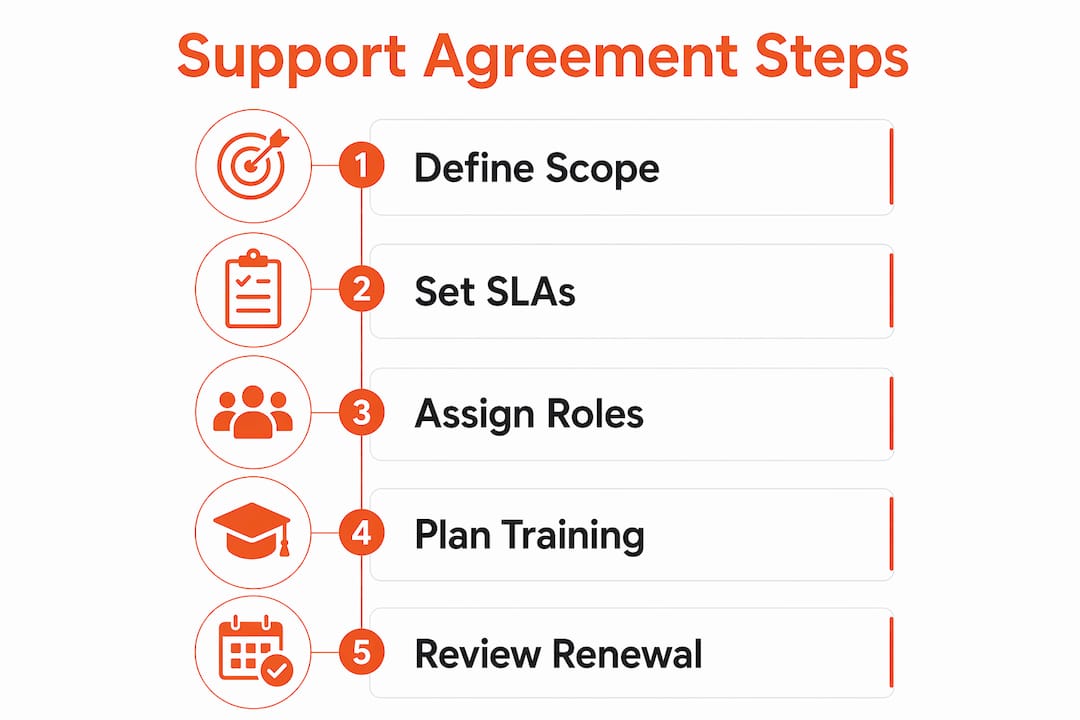
Training and Knowledge Transfer
The agreement must include provisions for onboarding internal teams, documenting known issues, and transferring system knowledge. A support team that learns about the product through customer complaints has already failed.
Pro Tip: Build a living knowledge base into the agreement as a deliverable. Require the vendor to update it monthly during the active support period. This protects you when team members turn over.
Duration and Renewal Terms
Specify the support period length, what triggers a renewal review, and what the exit criteria look like. Open-ended agreements without renewal terms tend to drift into underfunded, low-priority arrangements within six months.
How should you structure the post-launch support process?
Execution structure separates teams that handle post-launch well from those that scramble. The preparation work happens before launch, not after.
-
Enable internal teams before go-live. Document every known system behavior, edge case, and workaround. Teams that learn through customer complaints start from a failed support position. Training sessions, recorded walkthroughs, and written runbooks are non-negotiable deliverables.
-
Assign named owners for every support function. Monitoring, incident response, and release note documentation each need a single responsible person. Shared ownership without named accountability produces the same result as no ownership.
-
Set up monitoring and alerting tools before launch day. Uptime monitors, error tracking platforms, and performance dashboards must be live and tested before users arrive. Discovering a monitoring gap after a Severity 1 incident is a process failure.
-
Hold a 72-hour pre-launch go/no-go meeting. A formal support readiness check 72 hours before launch confirms that escalation procedures are documented, tools are configured, and every named owner knows their role. This meeting is a process gate, not a formality.
-
Define reporting cadence and metrics upfront. Agree on weekly status reports during the first 30 days, then monthly after stabilization. Reports should serve both technical leads and business stakeholders, not just one audience.
-
Schedule regular review sessions. Monthly reviews during the first quarter let you catch SLA drift, identify recurring issue patterns, and adjust the agreement before small problems become expensive ones.
Pro Tip: Run a tabletop simulation of a Severity 1 incident two weeks before launch. Walk every named owner through the escalation path in real time. You will find gaps in the plan that no document review would catch.
What are the most common mistakes in support agreement planning?
Most post-launch support failures trace back to decisions made weeks before launch, not to the incident itself.
-
Vague SLA language. Agreements that say "reasonable response time" or "best effort" give vendors no accountability target and give clients no recourse. Every time commitment must have a number attached.
-
Launching without enabling support teams. Internal support readiness is the most common gap in support planning. Teams that receive no training before go-live spend the first two weeks in reactive mode, which destroys user confidence fast.
-
Skipping escalation procedures. When a Severity 1 issue hits and no one knows who to call, minutes become hours. Escalation paths must be documented, tested, and distributed to every stakeholder before launch.
-
Underfunding the support budget. Industry standard budget allocation is 15–20% of the initial development cost annually. Most organizations budget far less and then wonder why support quality degrades by month three.
-
Treating launch as the finish line. Post-launch is not a one-time event. It is the beginning of an ongoing optimization cycle. Teams that close the project file after go-live consistently see performance drift and rising user frustration.
"Post-launch support is best treated as an ongoing mentorship phase, focusing on continuous system performance optimization and future constraint identification." — MiloSolutions
For a deeper look at how contract structure prevents these gaps from forming, Maestroforge covers app development contract essentials in detail.
Which tools and frameworks support effective service agreement planning?
The right tools do not replace a well-written agreement. They enforce it. Proactive monitoring, simple request workflows, and agreed scope coverage increase confidence and reduce frustration across internal teams.
SLA Management and Ticketing
Platforms like Jira Service Management, Zendesk, and Freshdesk all support tiered SLA tracking with automated escalation alerts. The key feature to require is SLA breach notification, which fires before a deadline passes, not after.
Monitoring and Alerting Systems
Tools like Datadog, New Relic, and PagerDuty provide real-time performance dashboards and incident alerting. Each tool integrates with ticketing systems so that a monitoring alert automatically creates a support ticket and notifies the named owner.
Escalation Matrix Template
Every support agreement needs a documented escalation matrix. The matrix lists issue severity, the first contact, the escalation contact, the time trigger for escalation, and the communication channel. A simple table in a shared document works. The format matters less than the fact that it exists and everyone has read it.
Go/No-Go Support Readiness Checklist
A pre-launch checklist should confirm the following before any go-live approval:
- All named support owners are confirmed and reachable
- Monitoring tools are live and tested
- SLA tiers and response targets are signed off by both parties
- Escalation matrix is distributed to all stakeholders
- Internal team training is complete with documentation delivered
- Reporting templates are ready for week-one use
Pro Tip: Store the escalation matrix, SLA document, and go/no-go checklist in a single shared location that every stakeholder can access without asking for permission. During a Severity 1 incident, no one has time to hunt for a document.
How do you measure and optimize your support agreement's success?
Measurement turns a support agreement from a static contract into a living management tool. The metrics that matter most are response time compliance, resolution time compliance, critical incident count, and user satisfaction scores.
Track SLA compliance weekly during the first 30 days. If response time targets are being missed consistently, the cause is almost always one of three things: understaffed support team, unclear escalation path, or monitoring tools that are not alerting fast enough.
The most reliable signal that your software has stabilized is 14 consecutive days without critical incidents. This milestone, sometimes called a "quiet period," is the standard exit criterion for the hypercare phase. Arbitrary calendar dates are a poor substitute for this evidence-based threshold.
Monthly review sessions should examine SLA compliance rates, recurring issue categories, and user satisfaction trends. Quarterly reviews should assess whether the support scope still matches the product's current state. Products evolve, and support agreements that do not evolve with them become liabilities.
Pro Tip: Add a formal agreement amendment clause that triggers automatically at the 90-day review. This keeps both parties accountable for updating the agreement rather than letting outdated terms govern a product that has changed significantly since launch.
Key takeaways
Effective post-launch support agreement planning requires named owners, tiered SLAs, pre-launch readiness checks, and a measurement framework that treats stabilization as a data-driven milestone, not a calendar date.
| Point | Details |
|---|---|
| SLAs must be contractual | Define severity tiers, response times, and resolution targets before launch day. |
| Named owners reduce delays | Assign a specific person to monitoring, escalation, and reporting to prevent accountability gaps. |
| Budget 15–20% annually | Allocate 15–20% of initial development cost each year to fund ongoing support properly. |
| 72-hour go/no-go check | Run a formal support readiness meeting 72 hours before launch to confirm all systems and owners are ready. |
| 14-day quiet period | Use 14 consecutive days without critical incidents as the evidence-based exit from hypercare. |
What i've learned about support agreements that most guides skip
Most post-launch support failures are not technical. They are organizational. The software works fine. The agreement is vague. The named owner is actually three people who each assumed someone else was watching.
After working through post-launch support planning with clients across different industries, the pattern I see most often is this: the support agreement gets written in the final week before launch, when everyone is exhausted and just wants to ship. That is exactly when the document gets the least scrutiny and the most damage is done.
The mindset shift that actually changes outcomes is treating the support agreement as a product in itself. It needs a draft, a review, a test run, and a named owner just like the software does. The 72-hour go/no-go meeting is not bureaucracy. It is the last chance to find the gap before users find it for you.
Budget allocation is where I see the most denial. Teams routinely plan for 5% of development cost in annual support and then act surprised when the system degrades by month four. The 15–20% industry benchmark exists because that is what it actually costs to maintain software well. Underfunding support is not a savings. It is a deferred cost with interest.
The best support agreements I have seen share one trait: they are boring to read because every scenario is already covered. No one is improvising during a Severity 1 incident. Everyone knows their role, their escalation contact, and their time window. That kind of clarity does not happen by accident. It happens because someone spent real time on the agreement before launch.
— Kaleb
How Maestroforge handles post-launch support for custom apps
Maestroforge builds post-launch support planning into every custom web and mobile application project from the start, not as an afterthought. The team creates tailored support agreements that include tiered SLAs, named escalation contacts, and monitoring setups specific to each client's operational needs.
For Northwest Arkansas businesses like Ozark Freight Partners, that approach translated into a 40% reduction in operational calls after launching a custom carrier portal. The support agreement was part of the delivery, not a separate conversation after go-live. If you are planning a software launch and need a custom support agreement built alongside your product, Maestroforge is ready to help you get it right before day one.
FAQ
What is post-launch support agreement planning?
Post-launch support agreement planning is the process of defining the scope, SLAs, escalation paths, and named responsibilities that govern software maintenance after a product goes live. It creates contractual clarity between clients and vendors before any issues arise.
What should an SLA include for post-launch software support?
A strong SLA defines issue severity categories, specific response and resolution time targets for each tier, escalation contacts, and the consequences for missing those targets. Vague language like "best effort" does not qualify as an enforceable SLA.
How much should you budget for post-launch software support?
Industry standard allocation is 15–20% of the initial development cost annually. Teams that budget below this threshold typically see support quality decline within the first two quarters.
When is it safe to exit the hypercare phase after launch?
The most reliable exit criterion is 14 consecutive days without a critical incident. This evidence-based threshold is more reliable than arbitrary calendar dates.
How do you set support expectations with a development vendor?
Define all support terms in the contract before work begins, including scope, SLA tiers, named owners, and reporting cadence. Maestroforge covers how to set developer expectations in a way that holds up after launch.