
Overbuilding is the single most reliable way a startup destroys its own momentum before a single real user ever weighs in. The industry term for this pattern is "scope creep," and it describes what happens when founders keep adding features to a product before validating whether the core idea works. 45% of MVP projects suffer scope creep, causing timelines to stretch 40 to 60 percent longer and budgets to overshoot by roughly 35 percent. That is not a minor inefficiency. That is a startup burning runway while its market moves on without it. Instagram launched with a single photo filter feature and grew to 1 million users in two months. The lesson is not that simplicity is charming. The lesson is that simplicity is a competitive weapon.
Why overbuilding kills startup momentum before launch
Overbuilding occurs when a founding team expands the scope of a product well beyond what is needed to test a core hypothesis. The minimum viable product, or MVP, is not a stripped-down version of a finished product. It is an experiment designed to generate learning as fast as possible. Many founders misunderstand MVP's purpose as a finished product rather than a learning vehicle, and that single misconception causes months of wasted development.
Several psychological forces push founders toward overbuilding. Perfectionism is the most common. Founders want to feel proud of what they ship, so they keep polishing. Fear of missing out drives feature additions because every competitor feature feels like a gap that must be closed before launch. The desire to impress investors leads teams to build dashboards, analytics panels, and admin tools that no early user will ever touch. Founders confuse building CI/CD pipelines and internal tooling with real progress, but real progress is measured by user actions and delivered value, not lines of code.
There is also what you might call the "perceived progress illusion." The team is busy. Standups are full. Tickets are closing. Everything feels productive. But if none of that activity is reaching users and generating feedback, the startup is not moving forward. It is running in place with an expensive engine.
- Perfectionism delays shipping by weeks or months while users remain unheard
- FOMO-driven feature additions inflate scope without validating demand
- Investor-impression building creates internal tools nobody outside the team uses
- Internal engineering activity feels like momentum but produces no learning
Pro Tip: Before adding any feature to your MVP backlog, write one sentence describing which user behavior it will change and how you will measure that change. If you cannot write that sentence, cut the feature.
How overbuilding physically slows a startup's growth
The consequences of overbuilding are not abstract. They show up in your calendar, your bank account, and your user retention numbers. Scope creep causes 40 to 60 percent longer timelines and roughly 35 percent budget overruns. For a startup with six months of runway, a two-month delay is not a setback. It is potentially fatal.

Shipping an MVP in 6 weeks instead of 6 months yields approximately 4.5 extra months of user feedback. That feedback is the raw material for product-market fit. Every week you spend building features nobody asked for is a week you are not learning whether your core idea actually solves a real problem.
The technical consequences compound over time. Early added features increase product complexity by introducing dependencies, edge cases, and failure points that slow every future change. A codebase built for 20 features is exponentially harder to modify than one built for 5. Teams that overbuild early spend more time debugging and less time shipping.
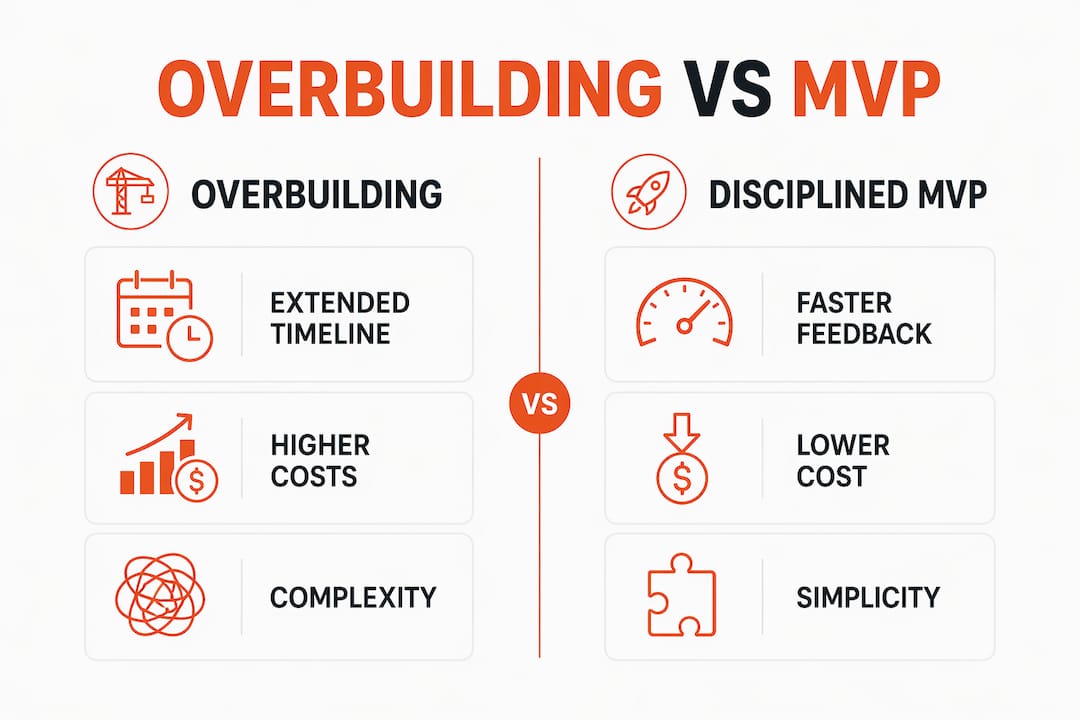
| Overbuilding consequence | Measurable impact |
|---|---|
| Extended development timeline | 40 to 60 percent longer than scoped |
| Budget overrun | Approximately 35 percent above initial estimate |
| Reduced deployment frequency | From 8 to 10 times per day down to 2 to 3 times per week |
| Delayed user feedback | Weeks to months of lost learning time |
| Increased debugging time | From minutes to hours per issue |
Hidden costs are the part most founders underestimate. Each feature adds ongoing costs including design updates, development changes, testing cycles, support tickets, and maintenance work. A feature that takes two weeks to build might consume two hours of engineering time every single week for the life of the product. Multiply that across a dozen unnecessary features and you have a significant ongoing tax on your team's capacity.
One of the starkest technical examples comes from premature architectural decisions. Early scale-focused architecture like microservices increases coordination overhead and slows deployment from 8 to 10 times per day down to 2 to 3 times per week. That reduction in deployment frequency is a direct reduction in learning speed. Fewer deployments mean fewer experiments, and fewer experiments mean slower product-market fit discovery.
Pro Tip: Track your deployment frequency as a health metric. If your team is shipping to production less than once per week, your architecture or scope may already be working against you.
Overbuilding vs. disciplined MVP development: what actually works
The contrast between overbuilding and disciplined MVP development is not a debate about quality. It is a debate about sequencing. Disciplined MVP development follows a "validate first, engineer second" approach. Validate first, engineer second sequencing limits premature investment and preserves runway until learning is concrete enough to justify the next build cycle.
Large companies can afford to build first and validate later because they have existing user bases, capital reserves, and brand recognition that absorb the cost of being wrong. Startups have none of those buffers. The startup's only structural advantage over a large competitor is speed. Overbuilding surrenders that advantage voluntarily.
Here is a practical sequencing framework for disciplined MVP development:
- Write your core hypothesis in one sentence. "We believe [user type] will [take action] because [reason]."
- Identify the single feature that tests that hypothesis most directly.
- Set an eight-week maximum build window. If your MVP takes over 8 weeks, it is likely over-scoped and has stopped functioning as a learning experiment.
- Ship to real users and define three specific metrics that will tell you whether the hypothesis is confirmed or rejected.
- Make your next build decision based on those metrics, not on internal opinions or investor suggestions.
Prioritization frameworks like MoSCoW (Must have, Should have, Could have, Won't have) and the Kano model help teams make scope decisions with less emotional friction. The goal is not to build a small product. The goal is to build the smallest product that generates a clear answer to your most important question.
Startups that learn fastest ship small experiments, measure honestly, and make decisions based on data rather than hope. That is not a philosophy. That is the operational definition of startup momentum.
Common pitfalls that trap founders in the overbuilding cycle
Knowing why overbuilding kills startup momentum is not enough. You need to recognize the specific traps that pull teams back into it even after they commit to lean development.
Stakeholder feature pressure is the most persistent trap. Every advisor, investor, and early user has a feature request. Each individual request sounds reasonable. Collectively, they compound into weeks or months of delay before real user feedback arrives. The solution is a written scope document that defines what the MVP will not do, reviewed at every planning meeting.
Premature architectural decisions are asymmetrically expensive. Some architectural decisions are costly to reverse, so choosing a microservices architecture or a complex data pipeline before you have validated your core product can lock you into expensive infrastructure that slows iteration for months. Choose the simplest architecture that works for your first 1,000 users, not your first million.
- Audit your backlog weekly and remove any feature that cannot be tied to a validated user need
- Set a written "not-building" list and share it with all stakeholders to manage expectations
- Use milestone planning to create hard scope boundaries at each development phase
- Conduct user interviews every two weeks to replace assumption-driven features with evidence-driven ones
- Measure retention and activation rates before adding any new feature to the roadmap
Founder fear of incompleteness is the emotional driver behind most of these traps. Shipping something that feels unfinished is genuinely uncomfortable. But the discomfort of shipping an imperfect product is far smaller than the cost of running out of runway before you find product-market fit. Reframe incompleteness as intentionality. You are not shipping a broken product. You are shipping a focused experiment.
Pro Tip: Replace the question "What else can we add?" with "What can we remove?" in every sprint planning session. The answer to the second question almost always improves the product more than the answer to the first.
Key takeaways
Overbuilding kills startup momentum by replacing user learning with internal activity, inflating timelines, and compounding technical debt before a single hypothesis is validated.
| Point | Details |
|---|---|
| Scope creep is the primary killer | 45% of MVP projects suffer scope creep, causing 40 to 60 percent longer timelines and 35 percent budget overruns. |
| Speed of learning beats speed of building | Shipping in 6 weeks instead of 6 months yields 4.5 extra months of user feedback critical for product-market fit. |
| Every feature carries hidden costs | Each added feature generates ongoing design, testing, support, and maintenance expenses that compound over time. |
| Architecture timing matters | Premature scale-focused architecture reduces deployment frequency from daily to a few times per week, slowing iteration. |
| Validate before engineering | Committing to "validate first, engineer second" preserves runway and prevents investment in unproven assumptions. |
The uncomfortable truth about building vs. learning
I have watched founders pour three months into a product that had 14 features, a polished onboarding flow, and a custom analytics dashboard. When they finally launched, users dropped off after the second screen. The features nobody asked for were not the problem. The real problem was that the team had spent three months answering questions nobody had asked yet.
The myth I see most often is that a more complete product signals seriousness to the market. It does not. It signals that the team values its own assumptions over user reality. The startups I have seen maintain real momentum are the ones that treat every build cycle as a question, not a statement. They ship something small, watch what happens, and let the data tell them what to build next.
Building for scale before validating with first users dulls the product's core value and slows momentum in ways that are genuinely hard to recover from. I am not arguing for shipping broken software. I am arguing for shipping software that is broken in the right direction. A product with one feature that works perfectly for ten users teaches you more than a product with ten features that works adequately for nobody.
The founders who preserve momentum are not the ones who build the most. They are the ones who learn the fastest and act on what they learn. Embrace imperfection as a strategy, not a compromise.
— Kaleb
How Maestroforge helps startups build less and learn faster
If you recognize your startup in any of these patterns, the fix is not a new process document. It is a development partner who treats scope discipline as a core deliverable, not an afterthought.
Maestroforge builds custom web and mobile apps for founders who need to move fast without building the wrong thing. The AI-augmented development approach at Maestroforge compresses timelines without inflating scope, so you get a working product in front of real users faster. Ozark Freight Partners reduced operational calls by 40 percent with a focused custom carrier portal, not a feature-heavy platform. That result came from building precisely what the problem required and nothing more. If you are ready to ship a product that validates your hypothesis instead of one that impresses your whiteboard, talk to the Maestroforge team about what lean looks like for your specific product.
FAQ
Why does overbuilding kill startup momentum so quickly?
Overbuilding replaces user feedback cycles with internal build activity, which means the team is making decisions based on assumptions rather than evidence. Scope creep alone causes 40 to 60 percent longer timelines, and every extra week without user data is a week of compounding misdirection.
What is the right size for an MVP?
An MVP should be scoped to fit within an eight-week build window. If the MVP exceeds 8 weeks, it has likely grown beyond a learning experiment into a premature product, which defeats the purpose of the validation phase.
How do you stop feature creep from stakeholders?
Create a written "not-building" list at the start of every development cycle and share it with all advisors and investors. Tie every feature request to a specific user hypothesis before it enters the backlog, and use milestone planning to enforce hard scope boundaries.
Does a simpler MVP hurt your chances with investors?
No. Investors fund traction and learning velocity, not feature counts. A product with clear user engagement data from a focused MVP is far more compelling than a polished product with no validated demand.
What is the biggest hidden cost of overbuilding?
The biggest hidden cost is ongoing maintenance. Each feature generates continuous costs across design, testing, support, and updates that accumulate long after the initial build, quietly consuming engineering capacity that should go toward validated improvements.