
An NDA for app development is a legally binding confidentiality agreement that prevents developers, contractors, and partners from disclosing or misusing your proprietary information. The standard industry term is a non-disclosure agreement, though you will also see it called a confidentiality agreement or secrecy agreement in legal contexts. Your source code, proprietary algorithms, business logic, and user data architectures all qualify as protectable assets under a well-drafted NDA. Federal law reinforces this protection. The Defend Trade Secrets Act (DTSA) gives founders a federal cause of action when trade secrets are misappropriated, making your NDA the first line of a multi-layer legal defense.
What should an NDA for app development explicitly protect?
The most common NDA failure is a vague or incomplete definition of "Confidential Information." Courts interpret ambiguous contracts narrowly, which means anything you forgot to list may not be covered.
Standard app development NDAs must explicitly define "Confidential Information" to include all of the following:
- Product concepts and feature roadmaps — your unpublished plans for what the app will do and when
- Source code and proprietary algorithms — the technical implementation that gives your product its competitive edge
- API credentials and integration keys — third-party service access that could be exploited if exposed
- User data architectures — how you collect, store, and process user information
- Internal financial projections — revenue models, pricing strategies, and investor materials
- Monetization strategies — subscription structures, in-app purchase logic, and ad frameworks
The distinction between trade secrets and general confidential data matters here. Trade secrets carry independent economic value and are not publicly known. General confidential data may include internal processes or vendor relationships that are sensitive but not necessarily secret in the legal sense. Your NDA should cover both categories explicitly, using separate definitions if necessary.
| Category | Examples | Protection Level |
|---|---|---|
| Trade Secrets | Source code, algorithms, data models | Highest — DTSA federal protection applies |
| Business Confidential | Roadmaps, financial projections | High — NDA contractual protection |
| Operational Data | API keys, access credentials | High — NDA plus access controls |
| Third-Party Data | User information, vendor contracts | Moderate — NDA plus privacy law compliance |

Precise definitions do more than satisfy a lawyer. They tell your developer exactly what they cannot share, which reduces accidental disclosure and makes enforcement far more straightforward.
When should you sign an app development confidentiality agreement?
Timing is the single most overlooked factor in NDA strategy. Most founders wait too long.
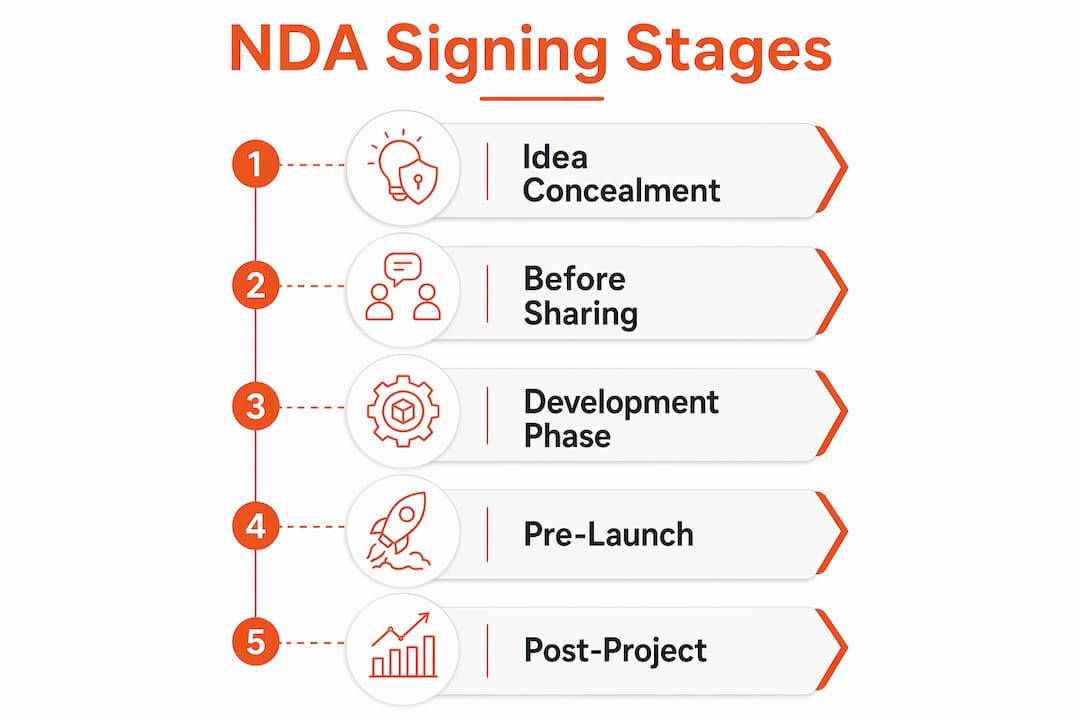
Founders should sign an NDA before sharing wireframes, technical requirements, monetization strategies, or prototypes. The moment you describe your app concept in a discovery call, you have disclosed information. If no NDA is in place at that point, you have no legal recourse if the developer uses your idea.
Here is the correct sequence for NDA execution in an app project:
- Initial contact. Send the NDA before the first substantive conversation. A brief intro call to confirm mutual interest is fine without one, but any discussion of your concept requires a signed agreement first.
- Discovery and scoping. Before sharing wireframes, user flows, or technical specifications, confirm the NDA is countersigned and dated.
- Vendor onboarding. Before granting access to Git repositories, staging environments, or cloud infrastructure, verify NDA coverage. Access to development environments must be secured by NDA before credentials are shared.
- Ongoing development. Revisit the NDA if the project scope expands significantly or new contractors join the team. Each new party needs their own signed agreement.
- Post-launch. The NDA should survive project completion. Confidentiality obligations typically continue for 2–5 years after the engagement ends.
Pro Tip: Keep a signed copy of every NDA in a dedicated legal folder with timestamps. If you ever need to enforce it, the date of execution relative to your first disclosure is the most critical piece of evidence.
Unilateral, mutual, or multilateral: which NDA type fits your project?
Choosing the wrong NDA structure creates legal gaps that undermine the entire agreement. Each type serves a distinct purpose.
Unilateral NDAs suit situations where only the client shares secrets. You disclose your app concept, and the developer is bound to keep it confidential. This is the most common structure for founders hiring freelancers or small development shops.
Mutual NDAs apply when both parties exchange proprietary information. If a development firm shares its internal frameworks, proprietary development tools, or pricing models with you, a mutual agreement protects both sides. Skipping a mutual NDA when the developer shares sensitive information creates a one-sided legal exposure that could complicate the relationship later.
Multilateral NDAs cover three or more parties. If your project involves a development firm, a design agency, and a third-party API vendor all working simultaneously, a single multilateral agreement is cleaner than managing three separate bilateral contracts.
Practical guidance for choosing:
- Hiring a freelancer or offshore team: Use a unilateral NDA. You are the disclosing party.
- Partnering with a development firm that shares its own IP: Use a mutual NDA to protect both sides.
- Running a multi-vendor project: Use a multilateral NDA or require each vendor to sign a standard unilateral agreement with you as the protected party.
- Working with investors or advisors during development: Use a unilateral NDA. Investors rarely sign mutual NDAs, but advisors typically will.
Avoid adding mutual obligations out of habit when only one party is disclosing. Unnecessary complexity creates negotiation friction and can delay your project start.
Critical clauses and pitfalls in NDA drafting for app development
A well-structured app development confidentiality agreement contains several clauses that generic templates routinely omit. Missing any one of them can cost you ownership of your own product.
IP ownership clause. This is the most critical provision. Generic NDA templates often omit IP ownership clauses, which means the developer may retain rights to code and design assets they created for you. Your NDA or accompanying contract must state explicitly that all work product, including source code, UI designs, and documentation, belongs to you upon payment.
Confidentiality duration. Avoid perpetual confidentiality durations because many jurisdictions, including California, disfavor or invalidate indefinite obligations. A realistic term is 2–5 years, or until the information becomes publicly available through no fault of the receiving party.
Usage restrictions. NDA agreements restrict not only disclosure but also use of confidential information, typically limiting it to project evaluation or delivery. A developer who does not disclose your source code but uses your algorithm in another client's project has still breached the agreement. Make sure your NDA covers misuse, not just disclosure.
Permitted disclosures and exceptions. Standard exceptions include information already in the public domain, information the receiving party knew before signing, and disclosures required by law. These are legitimate and expected. What you want to avoid is overly broad exceptions that swallow the rule.
Remedies for breach. Include a clause specifying that breach entitles you to injunctive relief without requiring proof of monetary damages. Courts can move quickly on injunctions, which is critical when source code is at risk of being copied or distributed.
Common pitfalls to avoid:
- Using a free online template without reviewing it for IP ownership language
- Failing to define "Confidential Information" with enough specificity
- Ignoring state law enforceability differences, particularly in California, New York, and Texas
- Omitting a governing law clause, which creates jurisdictional uncertainty if you are working with an offshore team
Pro Tip: Have a startup attorney review your NDA template once. A one-time legal review costs far less than litigating an IP dispute. Many attorneys offer flat-fee NDA reviews for under $500.
How ndas relate to trade secret protection and operational security
An NDA is a contract, not a magic shield. An NDA alone does not create trade secret status. Under the DTSA, information qualifies as a trade secret only when it has independent economic value and is subject to reasonable measures to keep it secret. Signing an NDA is one such measure, but it is not sufficient on its own.
"NDAs must be supplemented by operational security measures such as access controls, encryption, and need-to-know policies to qualify information for trade secret protection under the Defend Trade Secrets Act."
Practical operational security measures that strengthen your NDA's legal standing include:
- Role-based access controls on your codebase, so developers only see what they need
- Encrypted storage for source code and design files
- Two-factor authentication on all shared development environments
- Watermarking sensitive documents shared during discovery
- Audit logs showing who accessed what and when
The legal payoff for getting this right is significant. Willful and malicious misappropriation under the DTSA can result in damages up to twice the compensatory award. That multiplier only applies if you can demonstrate the information was a legally recognized trade secret, which requires both the NDA and the operational security practices to be in place. An NDA without access controls is a contract without context. Both are required.
Key takeaways
A well-drafted NDA for app development protects your source code, algorithms, and business logic only when it includes precise definitions, IP ownership clauses, and is backed by operational security measures.
| Point | Details |
|---|---|
| Define confidential info precisely | List source code, API keys, roadmaps, and user data architectures explicitly in the agreement. |
| Sign before first disclosure | Execute the NDA before sharing wireframes, prototypes, or any technical specifications. |
| Match NDA type to your situation | Use unilateral for solo disclosure, mutual when both parties share proprietary information. |
| Include IP ownership language | Generic templates often omit this clause, risking developer ownership of your code. |
| Pair NDA with operational security | Access controls and encryption are required alongside an NDA to establish trade secret status. |
Ndas in practice: what i've learned working with founders
Most founders treat the NDA as a formality. They download a template, send it over, and assume they are covered. That assumption is wrong more often than it should be.
The biggest misconception I see is that any signed NDA equals full protection. It does not. A vague NDA with no IP ownership clause and no usage restriction is barely better than a handshake. I have seen founders lose ownership of their own app code because the NDA they used said nothing about who owns the work product.
The second misconception is that asking a developer to sign an NDA will scare them off. Professional development firms expect NDAs as standard practice. A developer who refuses to sign a reasonable NDA is telling you something important about how they operate. That refusal is a red flag, not a negotiating position.
My practical advice: treat the NDA as the first test of your working relationship. A developer who engages seriously with the agreement, asks clarifying questions, and signs promptly is demonstrating the kind of professionalism you want on your project. For founders who want to learn more about protecting app project assets, the contract structure matters as much as the NDA itself.
The goal is not to create an adversarial dynamic. A good NDA sets clear expectations and lets both sides focus on building something great.
— Kaleb
Protect your app idea with Maestroforge
Building a custom app without the right legal foundation is a risk no founder should take. Maestroforge works with entrepreneurs across Northwest Arkansas to deliver tailored web and mobile applications, and that process starts with proper confidentiality protections built into every client engagement.
From the first discovery call, Maestroforge treats your concept, architecture, and business logic as proprietary. Clients like Ozark Freight Partners trusted Maestroforge with sensitive operational data and saw a 40% reduction in operational calls through a custom carrier portal. That kind of result requires trust, and trust starts with the right agreements. If you are ready to build your app with a team that takes IP protection seriously, start your project with Maestroforge today.
FAQ
What is an NDA for app development?
An NDA for app development is a legally binding confidentiality agreement between a founder and developers, contractors, or partners that prevents unauthorized disclosure or use of proprietary information such as source code, algorithms, and product roadmaps.
When should i have a developer sign an NDA?
Sign the NDA before sharing any wireframes, technical requirements, or prototypes. Any substantive conversation about your app concept requires a countersigned agreement to be in place first.
Does an NDA protect my app idea under trade secret law?
An NDA alone does not establish trade secret status. The Defend Trade Secrets Act also requires that the information have independent economic value and that you take reasonable security measures such as access controls and encryption.
What happens if a developer violates an NDA?
A breach entitles you to seek injunctive relief and monetary damages. Under the DTSA, willful and malicious misappropriation can result in damages up to twice the compensatory award, making a well-drafted NDA a powerful enforcement tool.
Should i use a mutual or unilateral NDA with my developer?
Use a unilateral NDA when only you are disclosing confidential information. Use a mutual NDA when the development firm also shares proprietary tools or frameworks with you during the project.