
Project managers in app builds are the central point of accountability for delivering applications on time, within budget, and at the required quality standard. The role of project managers in app builds spans delivery governance, cross-functional team coordination, and stakeholder communication across every sprint and milestone. Atlassian defines PMs as the link between high-level business goals and daily execution, responsible for removing obstacles and keeping teams focused on real business outcomes. In practice, that means coordinating engineers, designers, QA analysts, and product owners while managing tools like Jira and methodologies like Scrum or Agile from kickoff to launch.
What are the key responsibilities of app project managers?
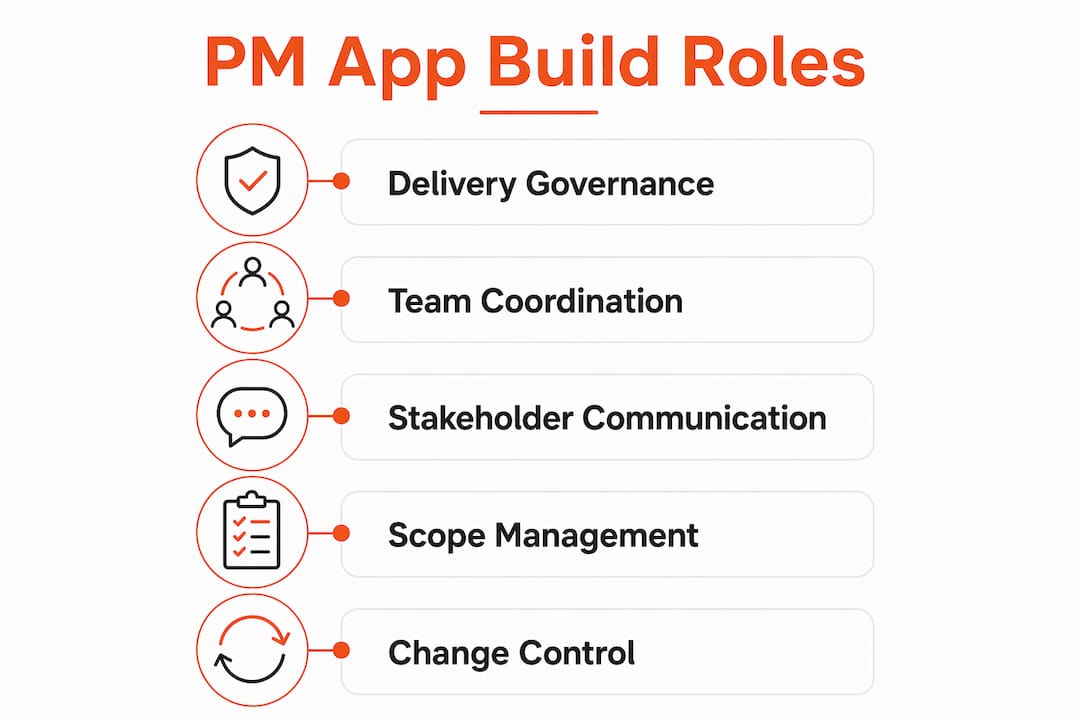
Project management in app development covers three distinct accountability areas: delivery governance, team coordination, and stakeholder communication. Each area carries specific obligations that, when neglected, produce scope creep, missed deadlines, or misaligned products.
Delivery governance
Delivery governance means owning the scope, schedule, and budget baselines throughout the build. The PM sets the initial project plan, tracks variance against it, and triggers formal change control when reality diverges from the plan. This is not a passive tracking function. The PM actively negotiates trade-offs between feature scope and delivery dates when constraints collide.
Team coordination
Successful PMs coordinate multidisciplinary teams based on skill, capacity, and role clarity, using tools like Jira and structured sprint ceremonies to align effort. Coordination means more than scheduling meetings. It means resolving conflicts between engineering estimates and design timelines, ensuring QA has adequate runway before release, and keeping product owners informed of technical constraints that affect backlog priorities.

Stakeholder communication
Core app build responsibilities include formal escalation paths and documentation standards that keep clients, executives, and internal teams aligned. The PM owns the communication plan, not just the status report. That distinction matters because a status report tells people what happened, while a communication plan defines who needs to know what, when, and through which channel.
Clarifying role boundaries
Confusing PM, Product Owner, and Scrum Master roles creates accountability gaps that directly threaten delivery success. The PM owns delivery execution and constraint management. The Product Owner owns backlog prioritization and acceptance criteria. The Scrum Master owns the Agile process and removes team-level impediments. These three roles can coexist on the same project without conflict, but only when each person understands where their authority ends.
- PM: Scope, schedule, budget, risk, and stakeholder reporting
- Product Owner: Feature prioritization, acceptance criteria, and business value decisions
- Scrum Master: Sprint ceremonies, team velocity, and process health
Pro Tip: Document role boundaries in the project charter before the first sprint. Verbal agreements about who owns what evaporate under delivery pressure.
How do project managers govern scope and change control?
Formal change control is the mechanism that separates disciplined app builds from chaotic ones. Without it, every stakeholder request becomes an implicit scope addition, and the original budget and timeline become fiction within weeks.
The Oracle change order framework describes a structured process that every PM should apply:
- Identify the change. Document the requested change in writing, including who requested it, the date, and the specific modification to scope, schedule, or budget.
- Assess the impact. Quantify the effect on timeline, cost, and risk before any approval decision. Change order management requires this impact analysis to prevent scope creep from accumulating unnoticed.
- Route for approval. Submit the documented change and its impact assessment to the appropriate authority, whether that is the client, a steering committee, or an internal sponsor.
- Update the baseline. Once approved, update budget and timeline baselines to reflect the new scope. This step is non-negotiable. Skipping it means the project will always appear to be running over budget even when changes were legitimately approved.
- Communicate the change. Notify all affected parties, including engineers, QA, and the client, so no one is executing against an outdated plan.
"PM scope-change control works best when tied to quantifiable impacts and routed through an approval lifecycle involving documentation, tracking, and baseline updates." — Oracle Project Management Documentation
The discipline of formal change control also protects the PM professionally. When a client questions why the app cost more than the original estimate, a complete change order log provides a clear, documented answer. Without that log, the PM has no defense.
Software project milestones serve as natural checkpoints for reviewing whether approved changes have shifted the delivery date. Reviewing milestone health after each approved change order keeps the schedule baseline credible rather than aspirational.
What communication strategies work best for app development teams?
Effective communication in app builds is not about volume. It is about precision, audience targeting, and documented decisions. ALKU emphasizes that PMs who maintain transparent communication channels keep internal teams, clients, and leadership aligned and responsive throughout the build.
The most effective PMs tailor their communication by audience:
- Executives and clients need outcome-focused updates: are we on track, what are the risks, and what decisions are needed from them? Weekly status reports with a red/amber/green indicator work well here.
- Engineering and QA teams need task-level clarity: what is the acceptance criteria, what are the dependencies, and what is the sprint goal? Daily standups and Jira board hygiene serve this audience.
- Product owners need scope and priority context: what has changed, what trade-offs are being considered, and what does the backlog look like against remaining budget?
Pro Tip: Create a decision log in Confluence or Notion from day one. Every material decision made in a meeting should appear in that log within 24 hours, with the decision, the rationale, and the names of who approved it.
Structured reporting routines and escalation paths maintain project visibility and enable timely resolution of issues before they become blockers. The escalation path should be defined in the project charter, not invented on the fly when a crisis hits. Knowing in advance that a budget overrun above 10% requires sponsor approval prevents the PM from making unilateral decisions under pressure.
Setting clear support expectations with developers from the start reduces the volume of ad hoc escalations that disrupt sprint velocity. When developers know the escalation path and the PM knows the team's capacity limits, communication stays structured rather than reactive.
How do pms lead distributed and outsourced app teams?
Distributed app builds amplify every coordination challenge that exists in co-located teams. Time zone gaps, cultural differences in communication directness, and the absence of informal hallway conversations all increase the risk of misaligned requirements and delayed decisions.
Distributed teams require formal decision logs, written sign-off procedures, and explicit authority delegation to avoid misaligned requirements and delays. The project system, whether that is Jira, Linear, or a comparable tracker, must be treated as the single source of truth. Verbal agreements made in video calls do not count until they appear in writing.
The table below maps the most common distributed team challenges to the PM practices that address them directly.
| Challenge | PM Practice | Tool or Method |
|---|---|---|
| Misaligned requirements | Written acceptance criteria before sprint start | Jira tickets with definition of done |
| Delayed decisions | Async decision log with 24-hour response SLA | Confluence or Notion decision log |
| Accountability confusion | RACI matrix documented in project charter | Project charter template |
| Scope drift | Formal change order for every scope addition | Change order workflow |
| Communication gaps | Audience-specific reporting cadence | Weekly status report template |
Role clarity becomes even more critical in outsourced builds. When the development team is external, the PM cannot rely on organizational culture to fill accountability gaps. The contract must define who owns delivery execution, who approves scope changes, and what the escalation path looks like when the vendor misses a milestone. App development contracts should codify these governance expectations before work begins, not after the first missed deadline.
The PM's job in a distributed build is to make the project system so authoritative and well-maintained that no team member ever needs to ask "what are we supposed to be building?" The answer should always be one click away.
Key takeaways
Project managers in app builds succeed by combining formal governance, precise communication, and clear role boundaries into a single, documented system.
| Point | Details |
|---|---|
| Governance is the foundation | PMs own scope, schedule, and budget baselines and must update them after every approved change. |
| Role boundaries prevent gaps | Clearly separating PM, Product Owner, and Scrum Master responsibilities stops accountability confusion before it derails delivery. |
| Change control protects the project | Every scope change needs a documented impact assessment and formal approval before work begins. |
| Communication must be audience-specific | Executives need outcome summaries; engineers need task-level clarity; product owners need scope context. |
| Distributed teams need written authority | Decision logs and formal sign-off procedures replace verbal agreements in remote or outsourced builds. |
What i've learned about the PM role that most articles won't tell you
Most project management content focuses on process: Agile ceremonies, Gantt charts, RACI matrices. Those tools matter. But the real differentiator between a PM who delivers and one who struggles is something harder to document: the willingness to have uncomfortable conversations early.
In my experience, the projects that go sideways rarely fail because the team lacked a good Jira board. They fail because the PM waited too long to tell the client that the feature list was incompatible with the budget. Or because the PM assumed the Product Owner and the Scrum Master had the same understanding of who owned a critical decision. By the time the gap surfaced, the team had built two weeks of work in the wrong direction.
The governance frameworks described in this article are not bureaucratic overhead. They are the infrastructure that makes those early conversations possible. When you have a documented change order process, telling a client "that request will cost four additional weeks" is not a confrontation. It is a procedure. The process removes the emotion and replaces it with data.
The other thing I would push back on is the idea that distributed teams are inherently harder to manage than co-located ones. They are different, not worse. A distributed team with a well-maintained Jira board, a decision log, and a clear escalation path often outperforms a co-located team that relies on hallway conversations and verbal agreements. The discipline required to manage distributed teams well is exactly the discipline that makes any app build more predictable.
If you are a team lead stepping into a PM role for the first time, start with role clarity and change control. Get those two things right, and the rest of the governance structure will follow naturally.
— Kaleb
How Maestroforge supports structured app project delivery
Maestroforge builds custom web and mobile applications for Northwest Arkansas businesses with the kind of project governance that most development firms skip. Every engagement includes defined scope baselines, formal change control, and clear communication cadences from day one.
Ozark Freight Partners saw a 40% reduction in operational calls after Maestroforge delivered a custom carrier portal built on exactly this kind of structured process. The result came from disciplined delivery, not just good code. If you are managing an app build and need a development partner who treats governance as a feature, not an afterthought, explore Maestroforge's custom app services to see how the team approaches project delivery for businesses that cannot afford to get it wrong.
FAQ
What is the primary role of a project manager in an app build?
The PM is the central point of accountability for delivering the app on time, within budget, and to the agreed quality standard. Atlassian defines this role as linking business goals to daily team execution while removing obstacles.
How does a PM differ from a product owner in app development?
The PM owns delivery execution, constraint management, and stakeholder reporting. The Product Owner owns backlog prioritization and acceptance criteria. Conflating these roles creates accountability gaps that directly threaten delivery success.
What is change control and why does it matter in app projects?
Change control is a formal process for documenting, assessing, approving, and implementing scope modifications. Oracle's change order framework requires impact analysis on budget and timeline before any change is approved, preventing scope creep from accumulating undetected.
How should pms manage communication with distributed app teams?
PMs should treat the project tracker as the authoritative source of truth and require written sign-off on all material decisions. Formal decision logs and documented escalation paths replace verbal agreements and reduce misalignment across time zones.
What tools do project managers use in app builds?
Jira is the most widely used tracker for sprint-based app builds, while Confluence and Notion serve as decision log and documentation platforms. Scrum and Agile provide the delivery methodology framework that structures sprint planning, daily standups, and retrospectives.